


When we talk about the transformation of Britain’s electricity networks, attention naturally gravitates towards the big numbers. This week’s Electricity Networks Sector Growth Plan (ENSGP) has some really big numbers:
- £181bn of investment in regulated electricity networks through to 2035
- More than 210,000 jobs supported
- £58bn of GVA
- Electricity demand expected to more than double by 2050
Those numbers are extraordinary. But they don’t tell the whole story.
One of the opportunities we may be underestimating is the role of independent distribution network operators (iDNOs), independent connection providers (ICPs) and multi-utility operators.
The UK isn’t just embarking on a regulated network investment programme. We’re creating a much bigger electrification market, and the electricity system is becoming larger, more distributed and more complex. By 2035, electricity networks are expected to support an additional 64 TWh of EV demand, 30 TWh from data centres and more than 2.3 million new homes, alongside significant growth in renewable generation, storage, heat and industrial electrification.
Increasingly, the businesses building the infrastructure behind that demand won’t simply require an electricity connection. A housing development, industrial site, data centre or transport hub will require electricity alongside water, communications, EV charging, storage and other infrastructure. Developers need organisations capable of navigating those interfaces and turning network capacity into something that can actually support investment. That is where the independent and multi-utility market has a potentially much bigger role to play.
Why does this matter?
Firstly, iDNOs and multi-utility operators sit close to the point where network infrastructure becomes economic growth.
A grid connection is increasingly a prerequisite for investment. Housing, logistics, EV charging, advanced manufacturing and digital infrastructure all depend on getting electricity capacity to the right place at the right time. The economic analysis behind the ENSGP makes the wider point clearly: additional network capacity allows businesses, housing developments, renewable generators and electricity-intensive projects to connect, invest and expand.
Secondly, independent operators can bring additional commercial models and investment into electricity infrastructure.
The regulated networks will undertake an enormous programme of investment. But we should think beyond a model in which the regulated network companies are viewed as the only organisations expanding electricity infrastructure. The opportunity is an ecosystem in which DNOs, iDNOs, ICPs, developers, manufacturers, investors and multi-utility providers each play to their strengths.
Thirdly, the multi-utility model can simplify infrastructure delivery for customers.
Large developments don’t experience infrastructure in neat regulatory silos. They need sites that work. Bringing multiple utility requirements together can reduce interfaces, improve coordination and create a proposition centred on what the customer is actually trying to achieve.
Finally, the independent sector expands the pool of capability available to UK plc.
The Skills Report that accompanies the ENSGP explicitly recognises that Britain’s electricity networks workforce extends far beyond the major network operators. It includes iDNOs, contractors, engineering consultancies, manufacturers, equipment suppliers and specialist service providers. It concludes that iDNOs are expected to play an increasingly important role in new connections and network expansion. But that report also excludes the independent sector, as well as nuclear build, renewables, water and EV, from the headline figures and analysis.
This isn’t a niche market
Perhaps the most striking finding is what happens when we look beyond regulated networks. The non-regulated market is expected to add, by 2050, demand equivalent to 23% of regulated transformer demand, 49% of high-voltage conductor demand and 37% of low-voltage conductor demand. That demand is being driven by housing, EV charging, data centres, renewables and wider electrification.
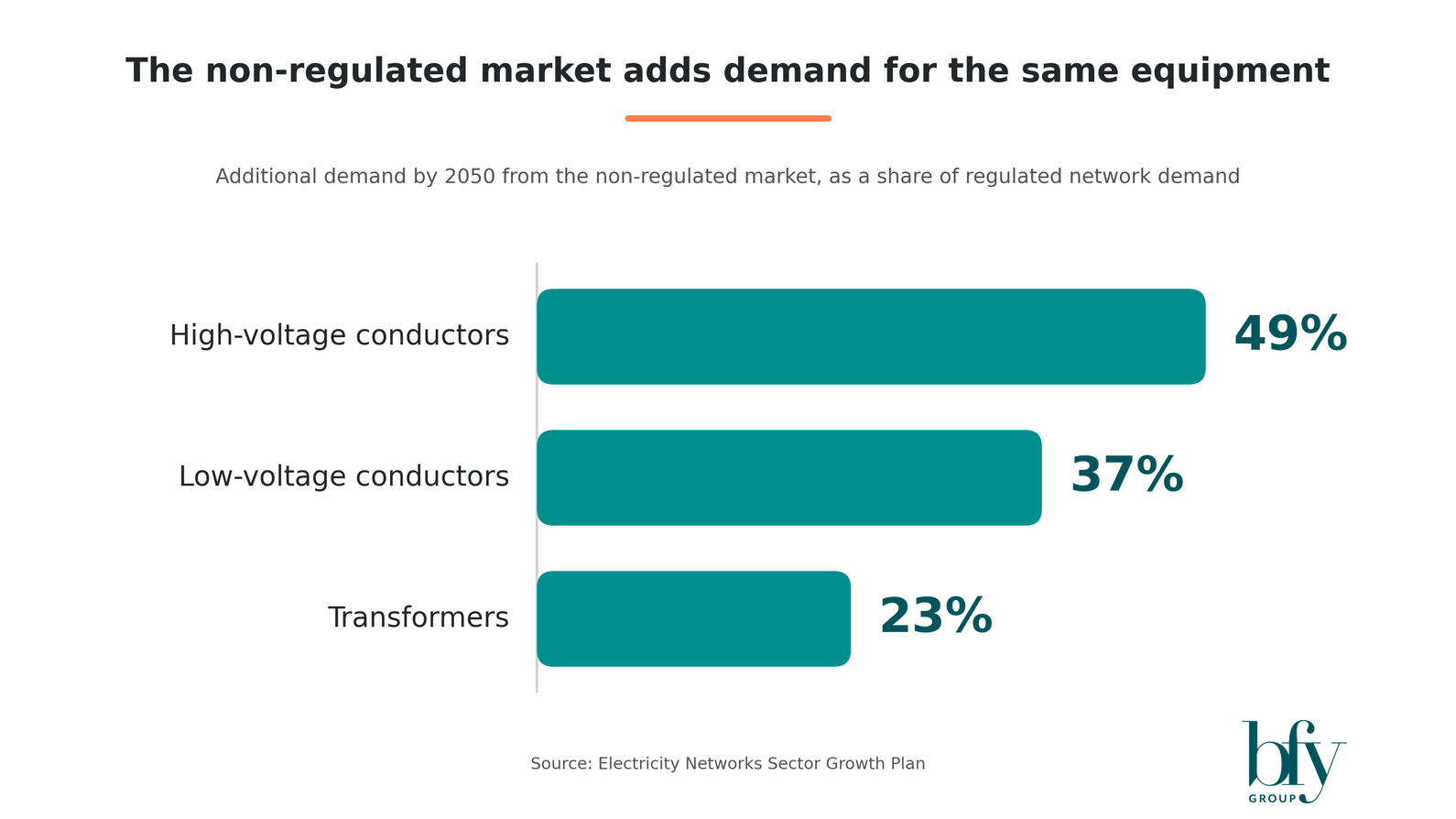
In other words, there is a significant parallel market developing for many of the same assets, services and skills required by regulated electricity networks. And that has an important consequence.
There is a catch: everyone needs the same things
The opportunity is substantial, but the regulated and non-regulated markets draw on many of the same constrained resources.
- Kit: Transformers. Switchgear. Cables.
- People: Cable jointers. Commissioning engineers. Protection engineers. Senior Authorised Persons.
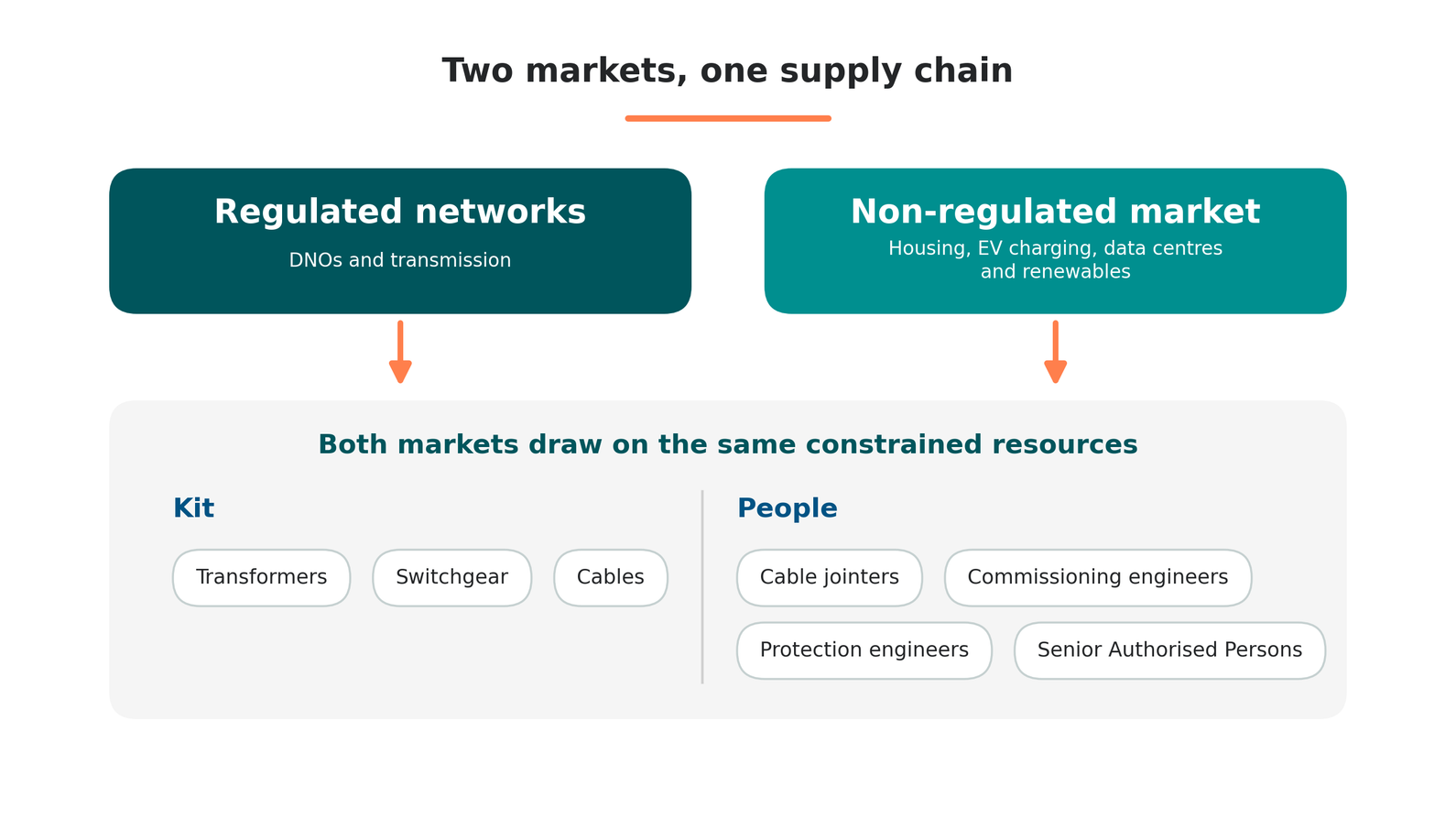
The ENSGP identifies growing pressure on equipment and specialist delivery resources, while the workforce analysis already finds shortages in several network-critical occupations. So simply growing the independent market without greater coordination risks creating more competition for the same equipment, factories and people. That’s why I think one of the most important ideas in the Sector Growth Plan is demand visibility.
- Manufacturers deciding whether to add a production line don’t just need to understand DNO demand
- Training providers deciding whether to invest in facilities don’t just need to understand transmission demand
They need visibility of the combined electrification market: regulated networks, iDNOs, housing, EV charging, offshore and onshore renewables, data centres and other major users.
The investment case changes when you see the whole market, and the ENSGP makes exactly this point. Non-regulated customers will be important to investment cases for new manufacturing and workforce capacity, while poorly coordinated signals risk exacerbating bottlenecks.
We need to broaden how we think about networks
For decades, it has been natural to think about an electricity network primarily through the lens of the regulated network company. That model is changing. The regulated networks remain at the heart of the system. But around them is a growing ecosystem of iDNOs, ICPs, multi-utility operators, manufacturers, contractors, developers, investors and technology providers. And the opportunity is to make that ecosystem work as a market, rather than seeing each component in isolation.
Do that well and we create something much more powerful:
- More investment
- More delivery capacity
- Stronger UK supply chains
- Greater competition and innovation
- Better propositions for customers
- And, crucially, faster economic growth
The electricity network of the future will not be built by one category of organisation. It will be built by an ecosystem. And I think iDNOs and multi-utility operators deserve a much bigger place in that conversation.
What do you think? Are we still underestimating the role the independent networks and multi-utility sector could play in Britain’s electrification?