


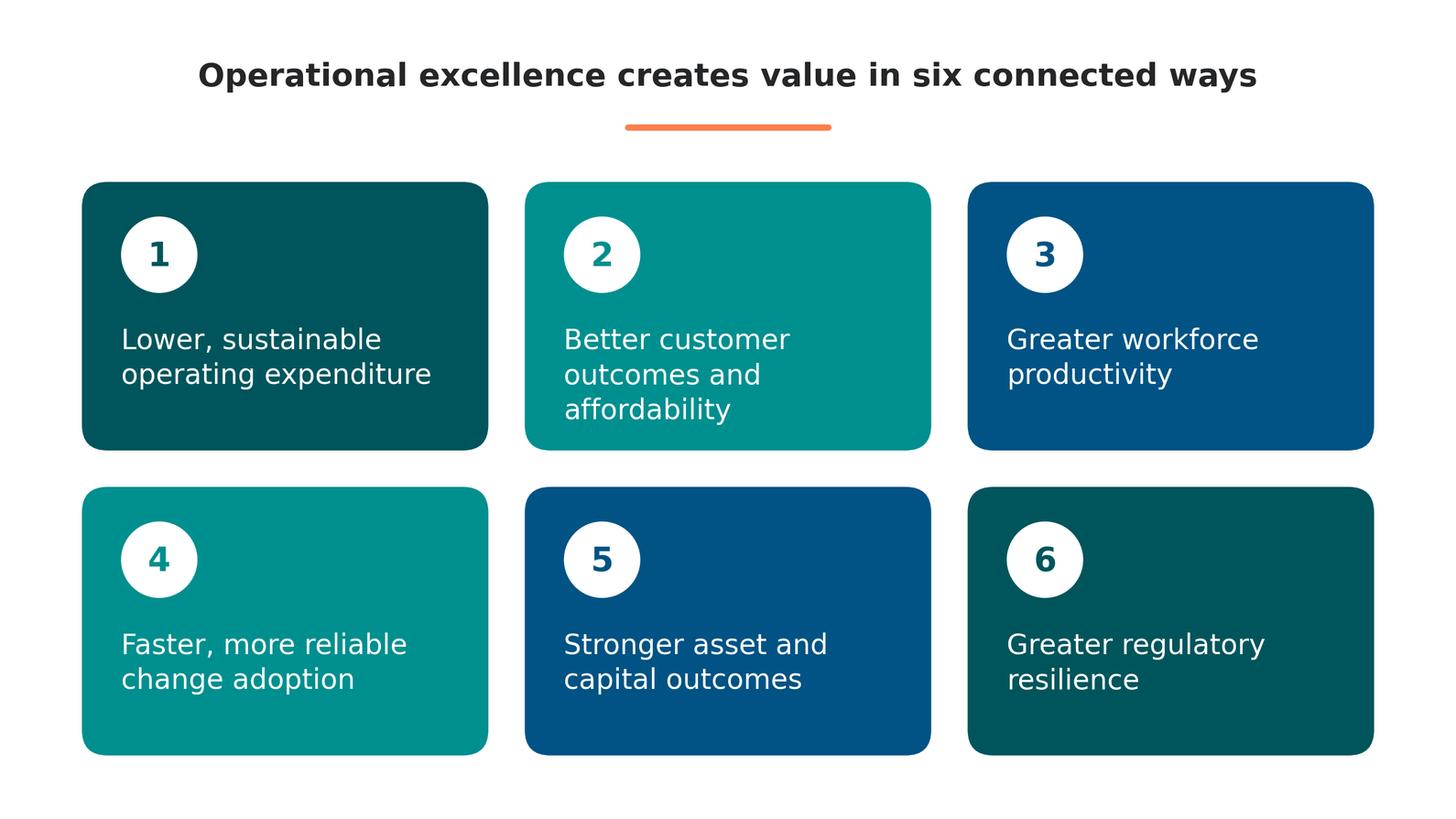
Operational excellence is more than a cost programme. Done well, it creates six forms of value: sustainable expenditure reduction, better customer outcomes, stronger workforce productivity, faster change adoption, improved asset decisions and greater regulatory resilience.
The tangible benefits of operational excellence
Operational excellence is often described as a methodology. The more useful view is that it is a capability.
Methodologies can be implemented, completed and forgotten. Capabilities become embedded in how organisations think, decide and operate. We characterise operational excellence as an ongoing culture of customer focus, problem-solving, teamwork, leadership and continuous improvement, rather than a one-off programme.
The GDN appeals underline why this distinction matters. A network may deliver a successful savings programme in one year, but ongoing efficiency assumes improvement continues. If the CMA confirms its provisional position by its 31 October 2026 deadline, the gas distribution companies will need to plan around Ofgem's 1% annual figure, rather than the 0.5% they sought. That calls for a lasting way of improving productivity, built into everyday work and repeated every year.
Benefit one: lower and more sustainable operating expenditure
Waste reduction, standardisation, automation and better process design can all reduce operating expenditure. But the most valuable savings often come from removing activity that should not exist at all.
Rework, repeat contacts, manual interventions, avoidable escalations, poor-quality data and failed field visits can create significant hidden cost. In our experience, complaint costs extend well beyond direct handling, into leadership, forecasting, training, quality assurance, risk and root-cause capability.
Operational excellence makes these costs visible, assigns ownership to their causes and creates a disciplined route to removal. The benefit is more resilient than a blanket cost reduction, because it releases capacity while improving the underlying process.
Benefit two: better customer outcomes and affordability
The CMA case directly connects productivity to consumer value. Citizens Advice has argued that regulated networks should be expected to outperform competitive-market benchmarks. Their innovation is funded by consumers, and guaranteed revenue lowers the risk of trying new approaches. It has also argued that a weaker ongoing-efficiency requirement risks consumers effectively paying twice at a time when energy bills remain an affordability concern.
Operational excellence supports affordability by improving the conversion of allowed revenue into outcomes. It can also improve the lived experience of customers through clearer communication, faster resolution, fewer failed appointments and better support during incidents.
We recommend grounding redesign in customer needs, journey mapping and evidence from feedback and complaints. This matters because a cost saving that increases customer effort or failure demand is unlikely to represent enduring value.
Benefit three: greater workforce productivity
Productivity is delivered by people, even when technology enables it.
Employees perform best when priorities are clear, information is reliable, leaders remove obstacles and teams have the authority to solve problems. We believe empowered people and internal problem-solving capability are essential to sustainable performance, and that standardisation creates a platform for learning and continuous improvement.
This does not mean asking the workforce to absorb endless additional demand. It means reducing time lost to poor preparation, duplicate entry, unclear decisions, unavailable materials, repeated approvals and preventable rework. Sustainable productivity should make work easier to perform correctly, not simply faster to perform under pressure.
Benefit four: faster and more reliable change adoption
Digital platforms, market reforms, smart technologies and data-driven operating models continue to reshape utilities. The challenge is not only delivering change, but ensuring operations can absorb it.
Our work suggests that delays can reduce benefit realisation by up to 30%, and that culture, skills, leadership, systems and communication all shape how well operational teams are prepared. In a settlement containing an annual efficiency assumption, delayed adoption has a double cost: the organisation incurs transformation expenditure while missing the productivity benefit its plan depends on.
Operational readiness should therefore be treated as part of the benefit case, not an activity scheduled near implementation.
Benefit five: stronger asset and capital outcomes
Operational excellence improves more than operating cost. It can sharpen investment prioritisation, improve maintenance effectiveness and create better evidence for asset decisions.
A mature operating system links asset risk, work history, actual condition, customer consequence and cost. That makes it easier to distinguish necessary intervention from low-value activity, and to demonstrate how expenditure contributes to safety, resilience and service, particularly important where efficiency pressure creates concern about underinvestment. A transparent, risk-based approach shows that productivity comes from better choices and execution, not simply from deferring essential work.
Benefit six: greater regulatory resilience
One of the most important benefits is regulatory resilience: the ability to respond credibly to changing assumptions, scrutiny and challenge.
The provisional CMA position suggests that weak economy-wide productivity does not automatically release networks from sector-specific ongoing-efficiency expectations. It also shows that precedent from another sector, in this case the CMA's 0.7% PR24 water assumption, doesn't necessarily determine the outcome for gas networks.
A company with a trusted baseline, governed improvement pipeline, balanced outcome measures and clear benefit evidence is better placed to:
- demonstrate that efficiency plans are realistic;
- explain how savings protect safety and service;
- identify emerging delivery gaps early;
- adapt initiatives without losing the overall trajectory; and
- show customers and regulators where benefits have gone.
Operational excellence therefore provides not only savings, but confidence: confidence that productivity is planned, evidenced and repeatable.
The leadership multiplier
Technology, automation and process redesign will not sustain improvement without leadership.
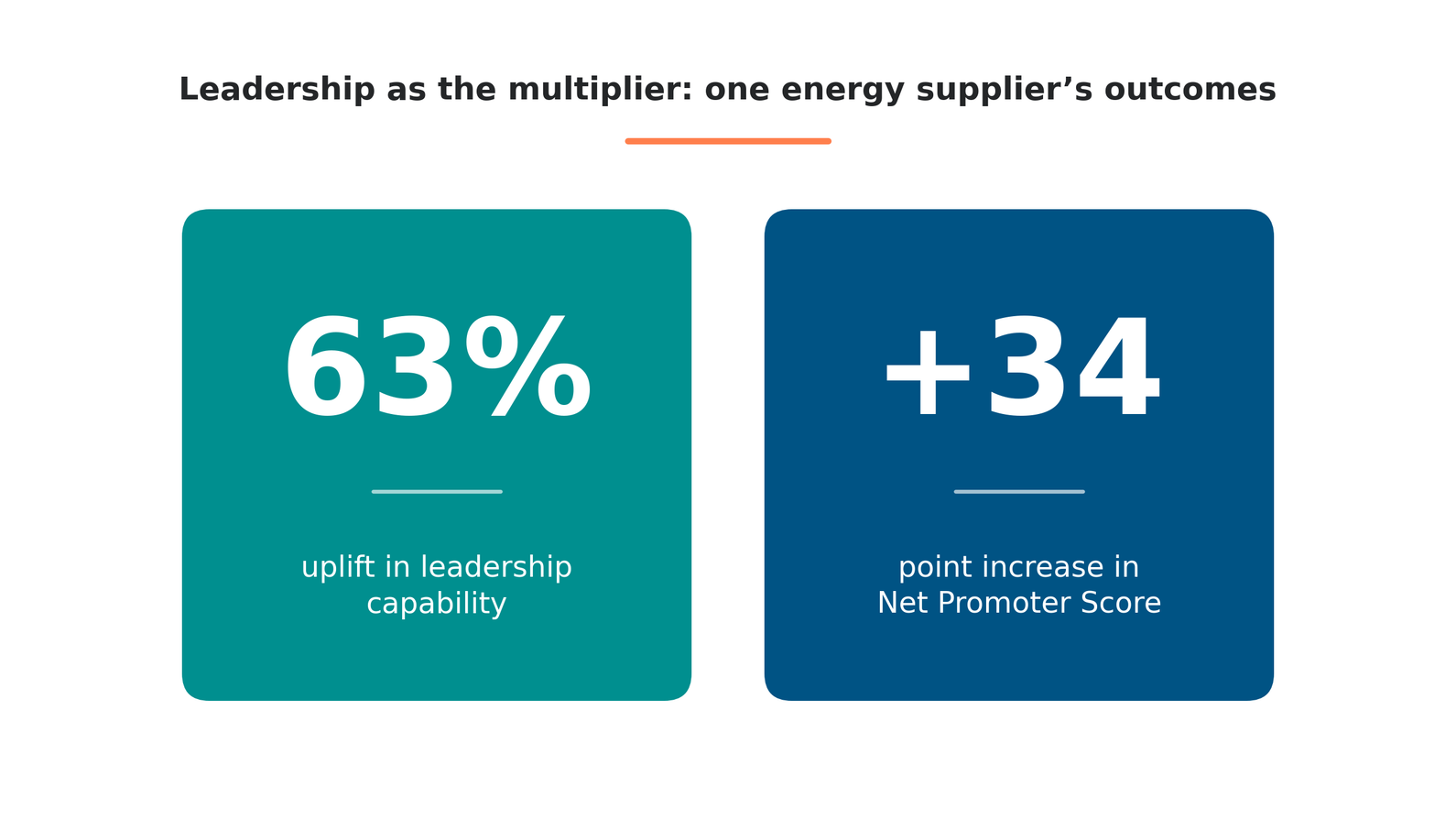
As part of a broader customer service transformation, one energy supplier achieved a 63% uplift in leadership capability and a 34-point increase in Net Promoter Score after combining leadership development with operational excellence. We have seen that leaders determine whether improvement becomes part of daily decision-making and culture, or remains another initiative that fades once attention moves on.
For network leaders, four behaviours are especially important:
- Protect the purpose: frame productivity as better value, not indiscriminate cost reduction.
- Make trade-offs explicit: ensure safety, resilience, customer outcomes and long-term risk remain visible.
- Create accountability: assign owners to benefits and end-to-end outcomes.
- Build improvement capability: equip managers and teams to diagnose and solve the next problem, not only implement the current solution.
From operational excellence to the licence to operate
Energy networks face a demanding combination of infrastructure growth, affordability pressure and regulatory scrutiny. The provisional GDN ruling makes clear that ongoing productivity may remain embedded in settlements even when companies argue that the wider economy cannot support it.
In that environment, operational excellence is not a support function, and not simply a cost-reduction methodology. It is the system through which networks convert people, technology, data and investment into demonstrably better outcomes every year.
The defining characteristic of high-performing networks will not be their ability to announce savings. It will be their ability to sustain productivity, protect customers and manage risk while delivering the infrastructure transition. Operational excellence is becoming part of the licence to operate.
Across this series, we’ve looked at why productivity is now a regulatory expectation, where networks can find it year after year, and what it delivers when it’s built into the way they work.
Discussion prompt: Does your organisation have a repeatable way of improving productivity, or a series of short-term efficiency programmes? |
If you’d like to talk through how a repeatable approach to productivity could work in your organisation, get in touch with Mark Hewett.