

Sustained productivity will not come from isolated projects. The greatest opportunities lie in connecting field service, asset management and customer operations into one end-to-end value chain, supported by the right data, governance and leadership.
Where the recurring savings are
Most energy networks have no shortage of improvement ideas. The harder task is deciding which opportunities can deliver measurable, repeatable and defensible productivity gains, year after year.
Under RIIO-3, the price control that runs from April 2026 to March 2031, Ofgem assumes networks will become 1% more efficient every year and reduces their cost allowances to match. The gas distribution networks appealed that figure as too high, and the Competition and Markets Authority (CMA) has backed Ofgem.
In practice, that means the savings have to keep coming every year. They can’t rely on a single transformation programme, a favourable mix of work or a periodic restructure. Networks need a steady pipeline of improvements across the activities that drive cost, risk and customer outcomes.
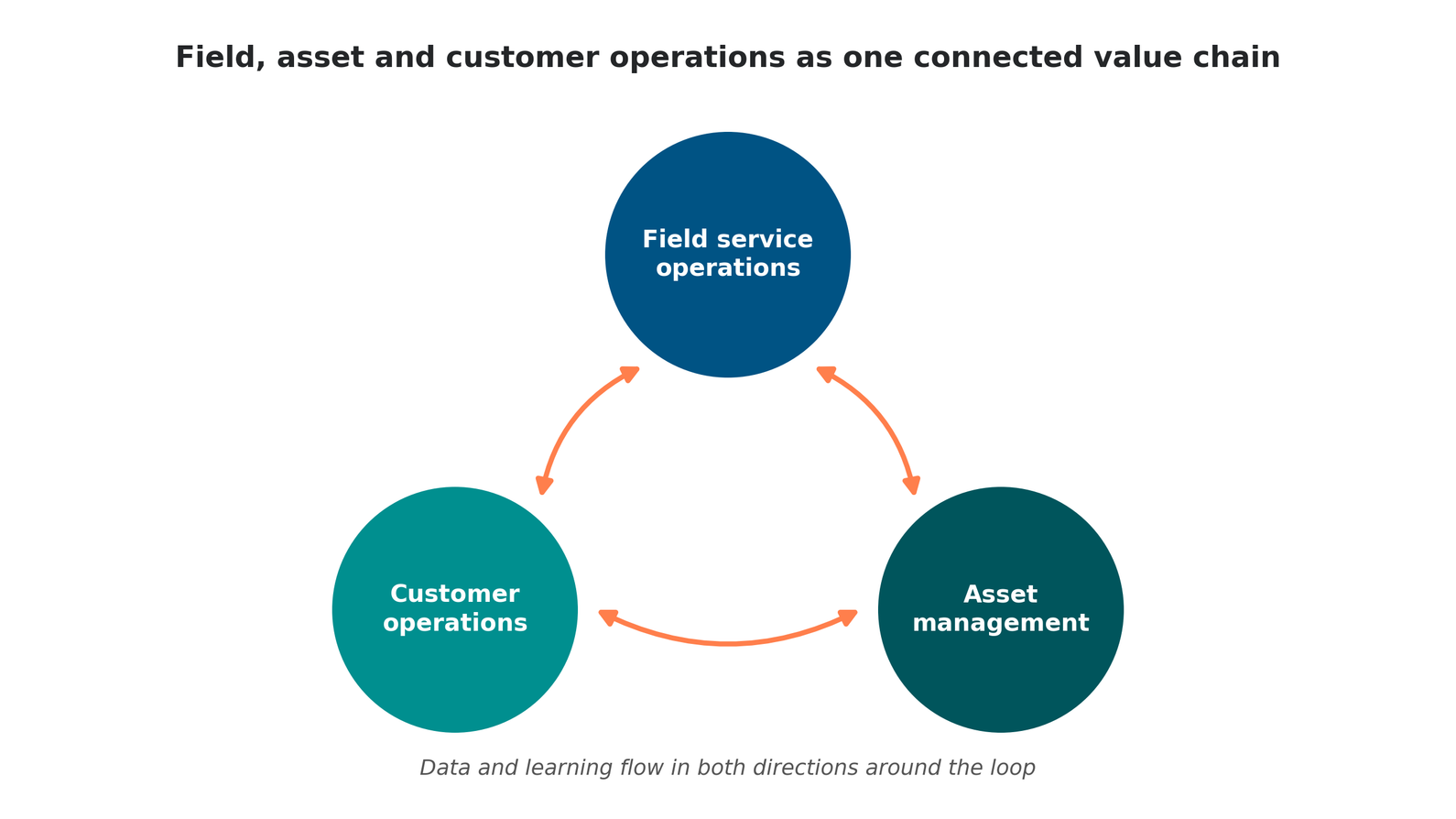
Three connected domains warrant particular attention:
- Field service management
- Asset management
- Customer operations
They should not be treated as independent programmes. The highest-value gains often sit between them, in the quality of work preparation, the flow of asset data, the translation of customer need into field activity and the feedback loop from completed work into future decisions.
Opportunity one: transform field service operations
Field operations are likely to sit at the centre of RIIO-3 productivity delivery. They represent a major controllable cost base and directly affect safety, reliability, asset condition and customer experience.
The inefficiencies are familiar: engineers travel unnecessarily; jobs are rescheduled because access, permits, materials or information are incomplete; work is repeated because the problem was not resolved first time; planners and dispatchers reconcile inconsistent systems manually; and local teams develop workarounds that mask systemic issues.
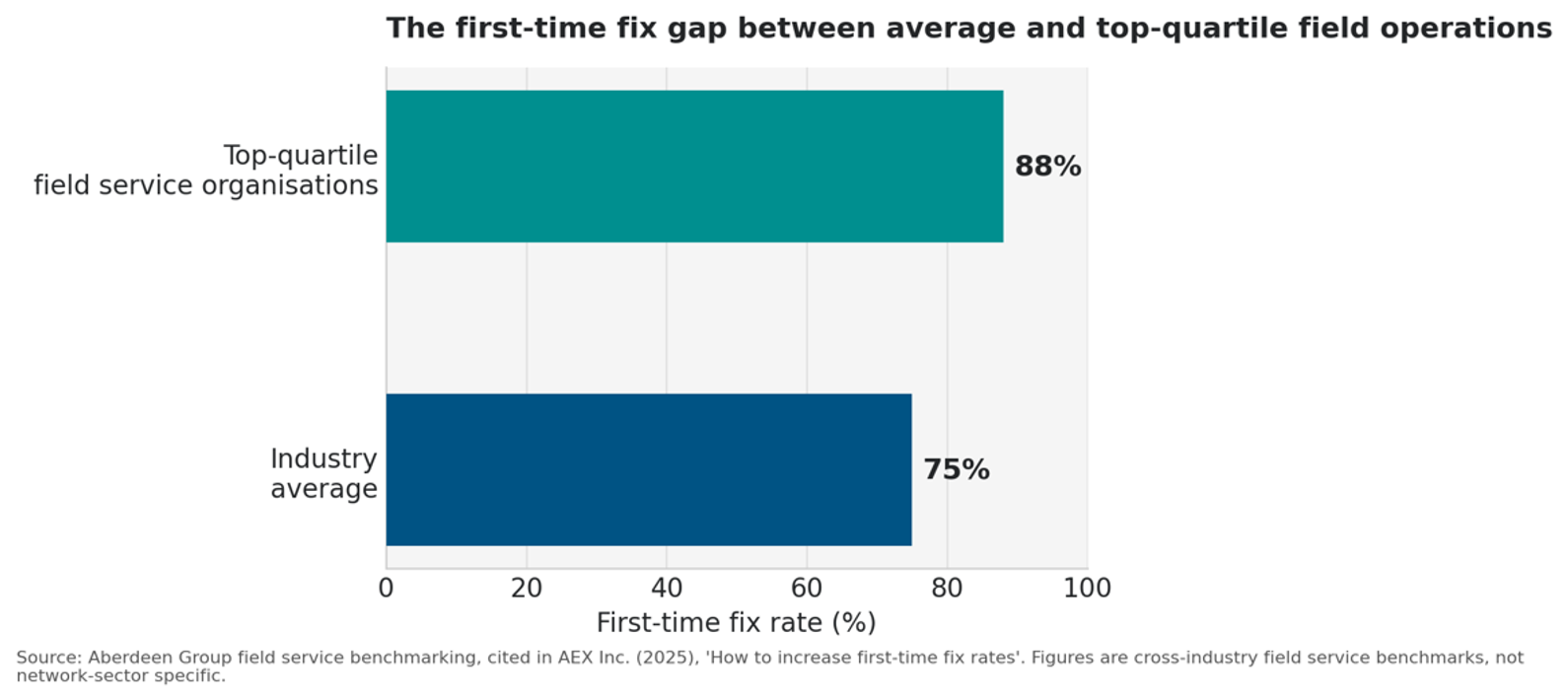
Cross-industry field service benchmarking gives a sense of the gap between average and leading performance. Aberdeen Group's research puts the average first-time fix rate at around 75%, meaning roughly one in four visits still requires a return trip, while top-quartile field service organisations consistently achieve 88% or higher.
A stronger field-productivity agenda should address five levers:
1. Work preparation
The cheapest failed visit is the one prevented before dispatch. Better validation of job scope, skills, materials, access, permits and asset data can increase ready-to-go work and reduce aborted activity.
2. Planning and scheduling
AI-assisted scheduling and optimisation can improve route efficiency, skill matching and resource utilisation. The objective should not be maximum diary density; it should be the best overall outcome once travel, risk, customer constraints and first-time completion are all considered.
3. Mobile enablement
Engineers need timely access to asset history, drawings, work instructions and customer information. Capturing structured data at source reduces downstream administration and improves the next planning decision.
4. First-time quality
Productivity measures should reward completed outcomes rather than apparent activity. Jobs per day can increase while total system productivity falls, if defects, repeat visits or follow-on work rise alongside them.
5. Closed-loop learning
Completion data, failure codes, deviations and engineer insight should feed back into planning, standards and asset strategies. Without this loop, the organisation repeatedly pays to rediscover the same problem.
Process mining can help expose process variants, dead ends and time-consuming loops in system data, while quantifying the cost of failures and informing targeted automation. The important shift is from using technology as an overlay to redesigning the underlying work.
Guardrail Measure completed outcomes, not isolated activity. Higher utilisation is not genuine productivity if defects, repeat visits or risk rise alongside it. |
Opportunity two: unlock asset productivity
Network operators create value through assets. Whether maintaining pipelines, pressure-regulation equipment, substations, transformers or overhead lines, the objective is to maximise safety, reliability and service at an efficient whole-life cost.
The RIIO-3 productivity debate makes asset productivity more important, not less. If annual efficiency improvement is embedded in allowances, networks need to extract greater value from maintenance, inspection and replacement expenditure without allowing risk to accumulate invisibly. Balancing cost, risk and performance in this way is the principle behind ISO 55000, the international asset management standard.
Four priorities stand out.
Risk- and condition-based intervention
Fixed schedules remain appropriate for some statutory and safety-critical activity, but not every intervention should be driven by calendar age. Condition, criticality, consequence and failure history provide a stronger basis for prioritisation.
Integrated asset data
Inspection records, work history, operational performance, customer impact and cost data need to connect. Fragmented data produces conservative decisions, repeated validation and avoidable manual work.
Whole-life optimisation
A lower short-term maintenance cost is not an efficiency if it raises failure, replacement or customer cost later. Decisions need a whole-life view that makes risk and future consequences explicit.
Learning from completed work
Actual condition found, intervention effectiveness, labour used and follow-on requirements should update asset models. This turns each job into evidence for the next decision.
The aim is better decisions about where intervention creates the most value, giving regulators and stakeholders a clearer line of sight from productivity initiatives to safety, resilience and customer outcomes.
Opportunity three: reimagine customer operations
Customer operations may not carry the same cost base as field delivery or asset management, but they provide an early-warning system for operational failure.
Customers judge network companies through communication, responsiveness, access, restoration information, complaint handling and support during disruption. Call logs, complaints, service reviews and journey analysis can reveal failures that are invisible in traditional performance reporting. BFY recommends using feedback, call logs, complaints, resolution times and demand patterns to ground process redesign in customer evidence.
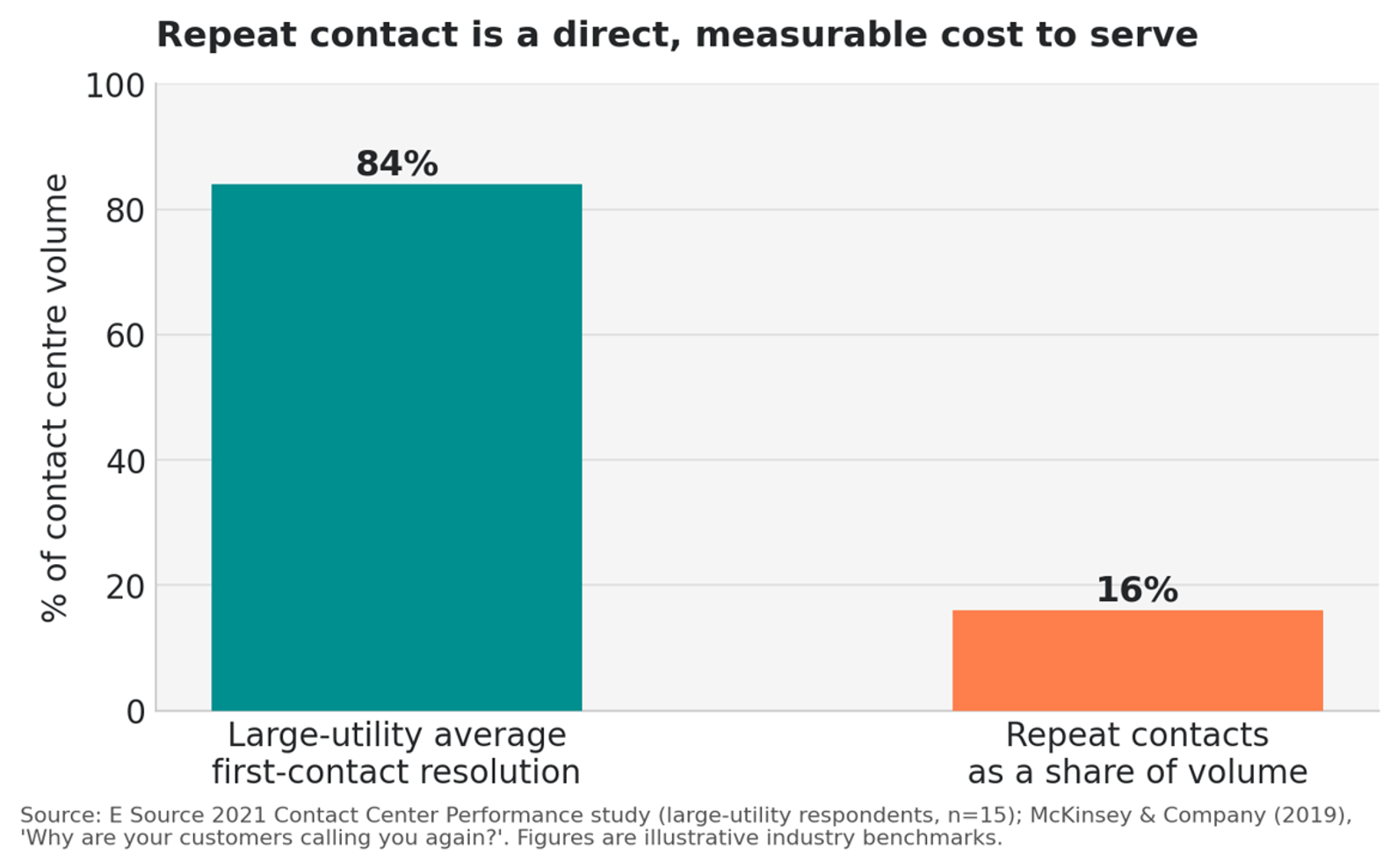
Repeat contact is especially valuable evidence, and expensive to ignore. Industry contact-centre benchmarking shows large utilities achieving average first-contact resolution rates of around 84%, still leaving roughly 16% of contacts as avoidable repeats.
Every avoidable call or escalation may indicate unclear information, a failed hand-off, an unresolved field issue or a system that cannot provide a reliable answer. Although Marlow's (2024) complaint-cost analysis focuses on financial services, its central lesson transfers directly: failure carries broad direct and indirect costs, and root-cause reduction is more valuable than handling failure efficiently.
AI and automation can support this agenda by summarising unstructured calls and correspondence, identifying recurring themes, routing work and handling routine workflows. But automation should follow diagnosis. Otherwise, the organisation risks automating demand that should have been prevented in the first place.
The operating model is the multiplier
Individual initiatives won’t deliver a 1% saving every year if the wider operating model works against them.
Ashley and Marlow (2026) identify broken hand-offs, unclear accountability, poor visibility, system friction and siloed optimisation as signs that a broader operating-model intervention may be required. These issues are particularly relevant where asset, field and customer teams measure different outcomes, or work from different versions of the truth.
Networks should align:
- Strategy: a clear definition of productivity that protects safety and outcomes.
- Accountability: named owners for end-to-end value streams and benefits.
- Governance: rapid decisions with clear risk thresholds and escalation routes.
- Data: common definitions, trusted baselines and visibility from action to outcome.
- Technology: targeted at diagnosed constraints rather than deployed as a generic solution.
- Leadership: managers equipped to coach, challenge and sustain new ways of working.
A practical productivity scorecard
A balanced scorecard can prevent local optimisation, where one function's improvement simply shifts cost or risk to another:
Financial: unit cost, realised recurring benefit and cost of rework.
- Operational: first-time completion, schedule adherence, ready-to-go work and backlog ageing.
- Asset: intervention effectiveness, risk reduction per pound and repeat defect rate.
- Customer: repeat contact, complaint drivers, customer effort and communication quality.
- People: productive time, capability, safety observations and improvement participation.
- Regulatory: delivery against outputs, service standards and the ongoing-efficiency trajectory.
The goal is not to maximise each measure independently. It is to understand the relationships between them, and manage productivity as a system.
Make the three work as one The strongest productivity gains occur where field service, asset management and customer operations work as one value chain. A customer contact should improve the operational picture. A field visit should improve the asset record. An asset decision should improve work planning. Completion data should sharpen future risk and investment decisions.
That connected loop is how operational excellence becomes repeatable, and how a regulatory efficiency assumption becomes a deliverable operating capability, rather than a recurring budget crisis.
Discussion prompt: Which hand-off between field, asset and customer operations currently creates the most avoidable cost or delay in your organisation? |
Mark Hewett
Director
Mark leads transformational change for UK energy and utility companies. His mission is to accelerate their journey to Net Zero, delivering on the promise of the energy transition and creating value for their customers, shareholders, and society across the energy value chain.
View Profile