


Why energy networks must deliver more with less
For much of the past decade, operational excellence was treated as a cost-reduction tool: a set of lean initiatives and process improvements that sat alongside the main business, rather than driving it. That view no longer holds.
Energy networks are being asked to invest heavily in infrastructure, improve customer outcomes and keep bills affordable, all while protecting safety, reliability and resilience. In most industries, those priorities are traded off against each other. In regulated energy networks, they increasingly have to be delivered together, and regulators are now assuming that productivity itself will keep improving, year after year.
Productivity is now a regulatory expectation
The Competition and Markets Authority's (CMA) provisional position on the gas distribution network (GDN) appeals sets out the direction of travel clearly. Cadent, Northern Gas Networks, SGN and Wales & West Utilities challenged Ofgem's assumption that they should deliver a 1% annual uplift in ongoing efficiency during RIIO-3. The networks argued for 0.5%, pointing to the wider UK productivity slowdown and to the CMA's own 0.7% productivity assumption in the PR24 water redeterminations. Ofgem's Final Determinations, published on 4 December 2025, nonetheless retained the 1% figure, and the CMA's provisional view (expected to be confirmed by its extended deadline of 31 October 2026) was that Ofgem was not wrong to do so.
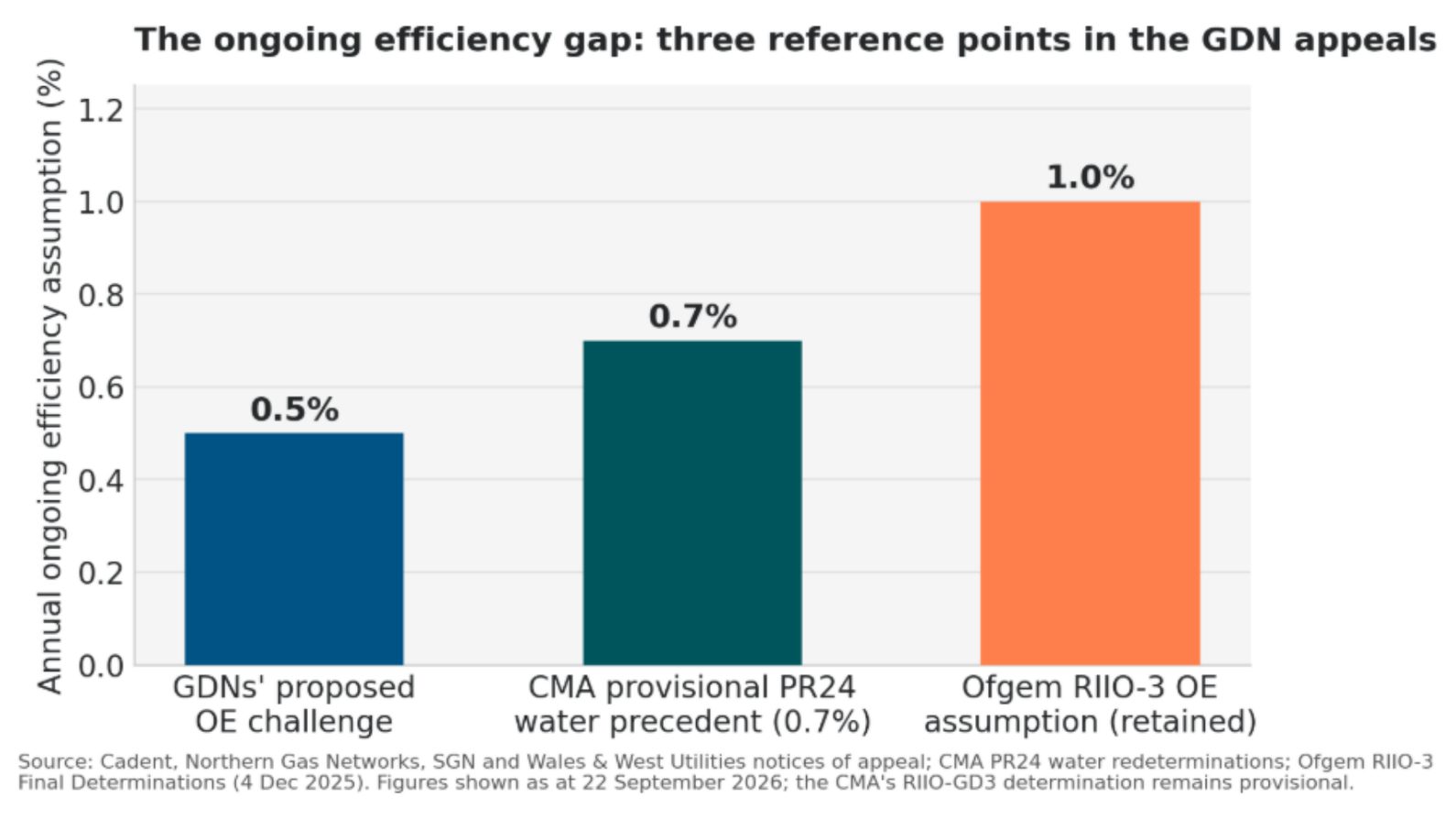
The significance runs deeper than the gap between 0.5%, 0.7% and 1%. Ongoing efficiency, often called the “frontier shift”, is not a one-off transformation benefit. It’s built into the cost baseline as an annual improvement that an efficient company is expected to deliver, every year, for five years. The provisional decision suggests that a weak economy-wide productivity backdrop does not automatically release networks from sector-specific expectations; the networks' own evidence, including data showing UK multifactor productivity growth close to zero for over 15 years, was not sufficient on its own to move Ofgem or the CMA off the 1% figure.
For network leaders, that changes the question. It’s no longer, “Where can we take cost out?” It’s, “How do we build an operating system that improves productivity every year, without weakening safety, resilience, service quality or workforce capability?”
Key point
A 1% annual efficiency expectation cannot be met sustainably through repeated rounds of indiscriminate cuts. It requires a repeatable productivity system.
A perfect storm of pressure
The efficiency challenge is intensifying just as the delivery agenda expands. Electrification, distributed generation, heat decarbonisation and electric-vehicle uptake are placing new demands on network infrastructure, at a scale Ofgem's RIIO-3 settlement itself reflects: £28.7bn of upfront investment was approved across the electricity transmission, gas transmission and gas distribution sectors, within a wider RIIO-3 investment pipeline of around £90bn. Customers increasingly expect clear, responsive and digitally enabled service on top of that build programme.
Our customer-experience research argues that process improvement should begin with an evidence-based understanding of customer needs and journeys, using feedback, call logs, complaints and resolution times to identify friction. Regulatory scrutiny is widening in parallel: customer outcomes, communication, vulnerability support, reliability and operational resilience are now central performance indicators. In energy retail, BFY has highlighted Ofgem's focus on billing and communication standards, alongside the importance of preparing people and operations for market change. Networks face an equivalent challenge: performance commitments must be delivered through operations, not simply documented in business plans.
Citizens Advice's intervention in the GDN appeals adds a consumer perspective that is hard to ignore. It has argued that regulated network companies, whose innovation is funded by consumers and de-risked by guaranteed revenue, should be expected to outperform competitive-market productivity benchmarks rather than merely match them. Setting the ongoing-efficiency requirement too low, it says, risks consumers effectively paying twice: once through allowances, and again for benefits an efficient company should already be delivering.
Productivity, in other words, is not simply a finance measure. In a regulated monopoly it is part of the compact between investors, companies and customers.
Why traditional cost cutting is the wrong response
A tougher efficiency assumption can tempt organisations towards familiar levers: vacancy freezes, blanket budget reductions, deferred training, cuts to support functions. These measures may improve a short-term cost line, but they do not necessarily increase underlying productivity.
Our experience cautions that making people do more with less can inhibit performance, creativity and growth, and that reductions in support capacity can become a false economy through lower customer satisfaction, reduced retention and higher colleague churn. In network operations, the equivalent risks are familiar: larger backlogs, poorer work preparation, repeated site visits, delayed maintenance, more manual intervention and increased operational risk.
Sustainable efficiency comes from reducing the work that should not exist in the first place. Repeat customer calls, avoidable field visits, rework, duplicate data entry, poor hand-offs, unnecessary approvals and manual workarounds are all forms of failure demand. Recent BFY analysis of complaints shows how failure creates not only direct handling costs but forecasting, quality-assurance, training, risk and management overheads on top.
Cost cutting reduces inputs and hopes outputs can be maintained. Operational excellence redesigns how value is delivered, so fewer inputs are required without degrading outcomes.
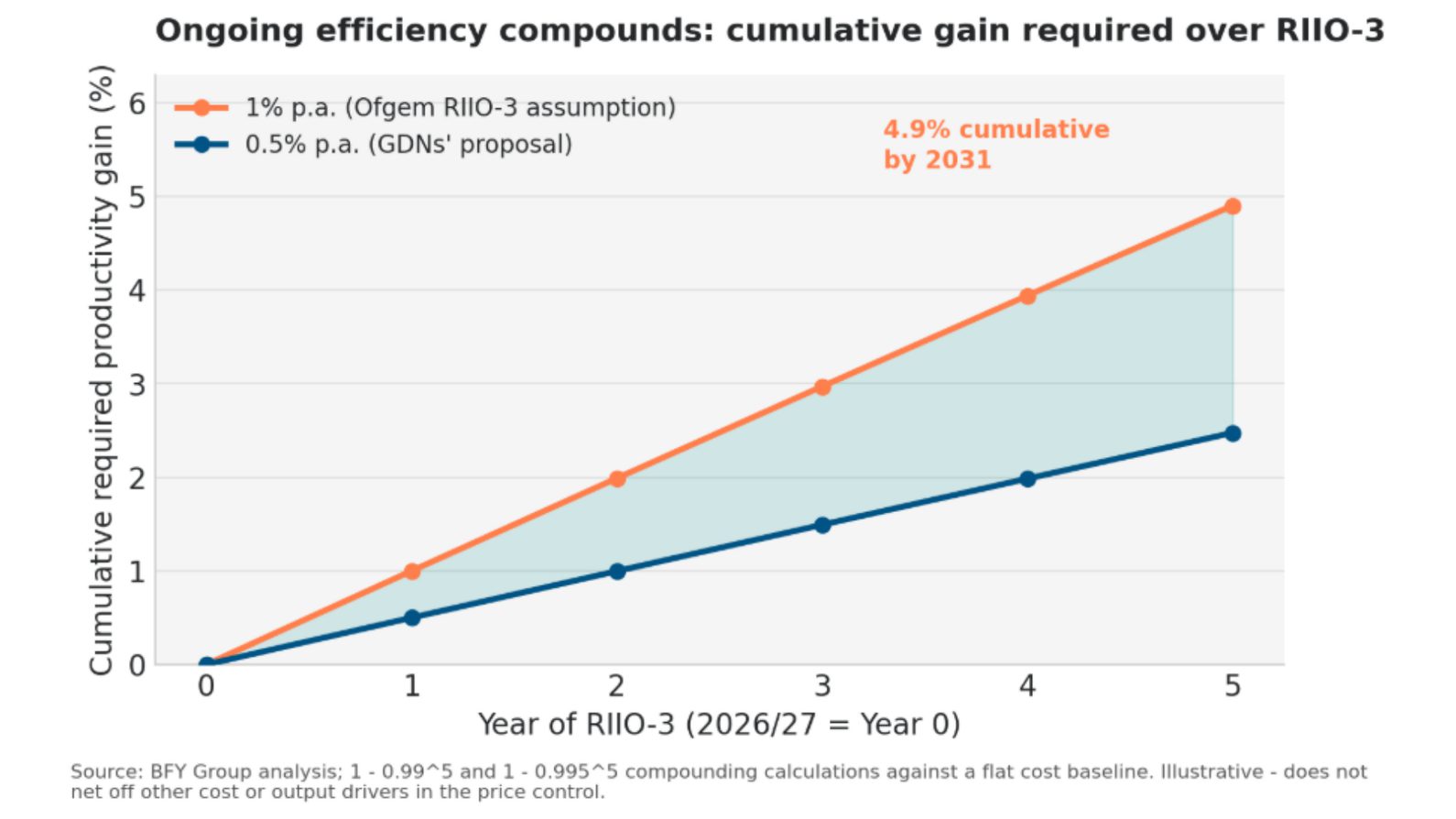
The scale of the challenge is easy to underestimate when looked at one year at a time. Because ongoing efficiency compounds, a 1% annual productivity requirement equates to approximately 4.9% cumulative improvement against a flat baseline by the end of RIIO-3 in 2031: nearly double the 2.5% a 0.5% assumption would require over the same five years.
From periodic savings to a productivity system
The strongest response is to treat ongoing efficiency as a portfolio of repeatable productivity mechanisms, not a single transformation programme.
Establish a transparent baseline
Networks need measures that distinguish genuine output improvement from volume changes, accounting movements or deferred activity. Cost per job, first-time completion, schedule adherence, productive time, backlog ageing, asset-intervention effectiveness, customer effort and whole-life cost each provide a different, complementary view of efficiency.
Build a governed improvement pipeline
Benefits should be identified, tested, implemented and tracked with clear owners. We describe operational excellence as creating a self-correcting mechanism through standardisation, problem-solving and continuous improvement, rather than relying on senior leaders to resolve every issue.
Design across end-to-end value streams
Improving field utilisation while allowing work quality to deteriorate merely shifts cost into repeat visits. Extending asset life without understanding risk may create future failure. Automating customer contact without fixing the underlying cause can make a poor journey faster, rather than better.
Develop leaders who can sustain the system
Our position is that process, systems and people transformation should be integrated. Without leadership capability, new processes attract workarounds, change fatigue grows and improvements lose traction.
Reconnecting cost and value
Cost and value are not opposing objectives: Investing upstream can create downstream savings. Our research shows how earlier intervention, better processes and improved colleague capability can reduce later recovery costs and improve service, a principle that applies equally to networks.
Better work planning may require investment in data quality, scheduling capability and front-line management. The return comes through fewer aborted jobs, lower travel, better utilisation and higher first-time completion. Improved outage communication can reduce inbound contact while improving trust. Better asset-health data can avoid low-value maintenance while directing resources towards higher-risk interventions.
The regulatory challenge should therefore not be framed as “doing the same work with less money.” It should be framed as “removing low-value work and improving the conversion of resources into outcomes.”
The new strategic capability
Operational excellence is becoming the organisational response to a regulatory environment that assumes continuous productivity improvement. The networks that outperform in RIIO-3 will not necessarily be those that invest most heavily in technology. They will be those that connect technology, data, process, leadership and workforce capability into an operating system that improves year after year.
The question is no longer whether networks can identify another round of savings. It is whether they can repeatedly deliver the productivity improvement embedded in their regulatory settlement, while protecting customers, assets and long-term capability.
Where is your organisation's next productivity improvement coming from, and can it be sustained without moving cost or risk elsewhere?