


This article follows on from Why digital investment isn’t hitting the mark for regulated networks by Sam Chapman and Mark Hewett. I’d encourage you to read it first.
The question most senior leaders cannot yet answer confidently
If your regulator asked you today to walk them through the connection between your digital investment portfolio and the operational outcomes you have committed to, how confident would you be? Not in the narrative. In the evidence. Not in the next price control, but right now.
For most senior leaders in network operators, that question lands somewhere uncomfortable. Not because the ambition is wrong, or the investment insufficient, but because the gap between commitment and delivery is not where organisations tend to look for it. It’s not in the portfolio, the technology or the plan. It’ is in the behaviours of the people leading it, and it cannot be delegated.
My BFY colleagues, Sam Chapman and Mark Hewett, have set out why digital investment is not hitting the mark for regulated networks, and the four shifts that separate organisations genuinely building delivery confidence from those that are not. This article is about what those shifts demand of the leaders responsible for driving them.
The three leadership pressure points
When digital programmes struggle in network operators, technology problems are rarely the whole story. The more persistent gaps tend to emerge in three places, each of which is a leadership problem before it’s anything else.
The connection between senior leadership and delivery reality stretches. Programmes are stood up with strong sponsors and clear intent, but as pressure builds and priorities compete, progress gets reported upwards rather than genuinely understood. By the time the gap between plan and reality becomes visible, the window for early intervention has already gone. In a fixed control period that window is unforgiving: funding, outputs and incentives were settled years in advance, and lost time cannot be renegotiated. The plan still looks credible. The delivery isn’t. And the evidence a regulator would expect to see of control being exercised in-period is incomplete or simply doesn’t exist, because nobody was close enough to exercise it.
Initiatives are completed but the capability doesn't land. A programme delivers to time and budget, the team stands down, and six months later nobody can clearly say who owns the resulting capability, whether it’s performing as intended, or what good looks like day to day. The initiative succeeded on its own terms, but the capability it was meant to create is fragile. This is precisely what price control deliverables and outcome incentives increasingly test: not whether the investment was made, but whether the capability it funded is demonstrably improving network performance. The evidence chain breaks at exactly the point the programme was declared a success.
Digital means something different depending on who you ask. Technology teams think in platforms and data architecture. Operations teams think in network reliability, risk and service continuity. Finance and regulatory teams think in compliance, cost control and defensibility. When these perspectives are not actively aligned, investment decisions get made against different assumptions, assurance processes cover different risks, and the evidence base ends up built to different specifications in different parts of the business. The commitments made in business plans and digitalisation strategies read as coherent on the page, while the organisation’s ability to evidence them quietly fragments underneath.
What closing that gap actually requires
The shifts my colleagues Sam and Mark describe have a leadership corollary, a set of disciplines that senior leaders need to apply personally rather than delegate. These are behaviours, not structures, and they look like something specific in practice.
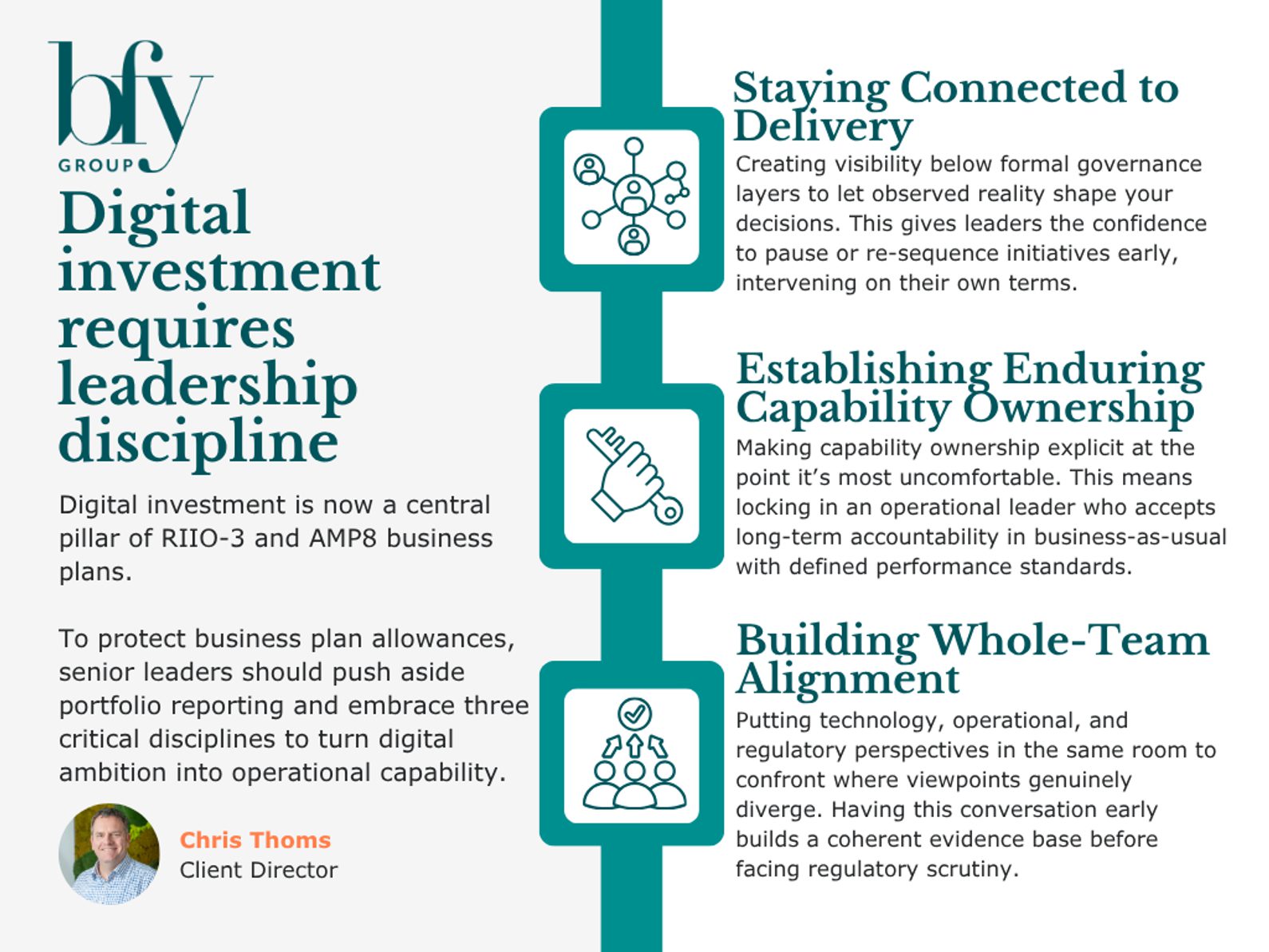
Staying close enough to delivery to change decisions, not just digest reports. Leaders who build real delivery confidence deliberately create visibility below the formal governance layers. They spend time with delivery teams rather than relying on what reaches the board pack, test assumptions directly, and pay attention to the places where reported status and observed reality diverge. But visibility on its own is not the discipline. The discipline is allowing what you see to shape the decisions you make: knowing where delivery risk is building now, where ambition is running ahead of capability, and what should not be progressed yet. That last call is the hardest to hold, because in a fixed price control framework, re-sequencing or pausing an initiative is real money against settled allowances. Leaders who exercise that restraint early are intervening on their own terms. Leaders who don’t are explaining variances to their regulator later, on someone else’s. The question to carry into every review is not “are we on track?” but “what would cause this to fail, would we see it in time, and what are we going to do differently as a result?”
Making capability ownership explicit at the point it’s most uncomfortable. The moment an initiative closes is the moment this discipline is tested. It means refusing to declare success until a named owner has accepted accountability for the capability in business as usual, with a defined performance standard and an agreed answer to what happens when it’s not met. It means being willing to say a programme has delivered but the capability has not yet landed, and holding that position under pressure to move on. Capabilities in this sector must outlast the programmes that build them, often across control period boundaries, and that longevity starts with ownership.
Treating the definition gap as a leadership problem, not a governance one. No terms of reference or operating model document closes this gap. It closes when a senior leader puts technology, operations and regulatory perspectives in the same room, surfaces where their viewpoints of digital genuinely diverge, and builds a shared understanding of what digital capability is for in the organisation and how its success will be evidenced. That conversation is uncomfortable precisely because the divergence is real. Leaders who have it early build coherence into the evidence base. Leaders who avoid it discover the divergence during regulatory scrutiny, when it’s most painful to address.
The standard has shifted
The DSO transition in electricity distribution, the arrival of heat network regulation, the scale of RIIO-3 and AMP8 commitments, and the emergence of AI as a genuine operational capability question are all raising the bar for what digital leadership across network sectors must deliver. The organisations getting this right are not necessarily those with the largest digital portfolios or the most sophisticated technology. They are the ones whose senior leaders have built the habits and disciplines to keep delivery connected to commitment, in-period, under real operating conditions.
Which brings us back to the opening question. If your regulator asked today, could you walk them through the connection between your digital investment and your committed outcomes? Not in the narrative. In the evidence. If the honest answer is not yet, the gap is unlikely to be in your plan. It will be in the leadership behaviours that connect it to delivery, and those can be built.
If these questions resonate, whether you are navigating RIIO-3 or AMP8, building delivery confidence across electricity, gas, water or heat networks, or working to align your digital and operational agenda, I’d welcome the conversation. Get in touch.