


We spend a lot of time in the energy sector talking about improvement: faster connections; smarter grid management; more efficient price controls. These conversations matter. But they all share a common assumption, that the system and structure we're working with is suitable.
We're not sure it is.
In the energy industry, we're navigating constraints of legacy systems, structures and governance that we can't easily change. Now, imagine a network that can meet the short-term challenges and long-term aspirations of governments and the general public. It would look very different from what we have today. So how do we work with what we’ve got to get to where we need to be?
Three things stand out for us: planning, regulation and funding.
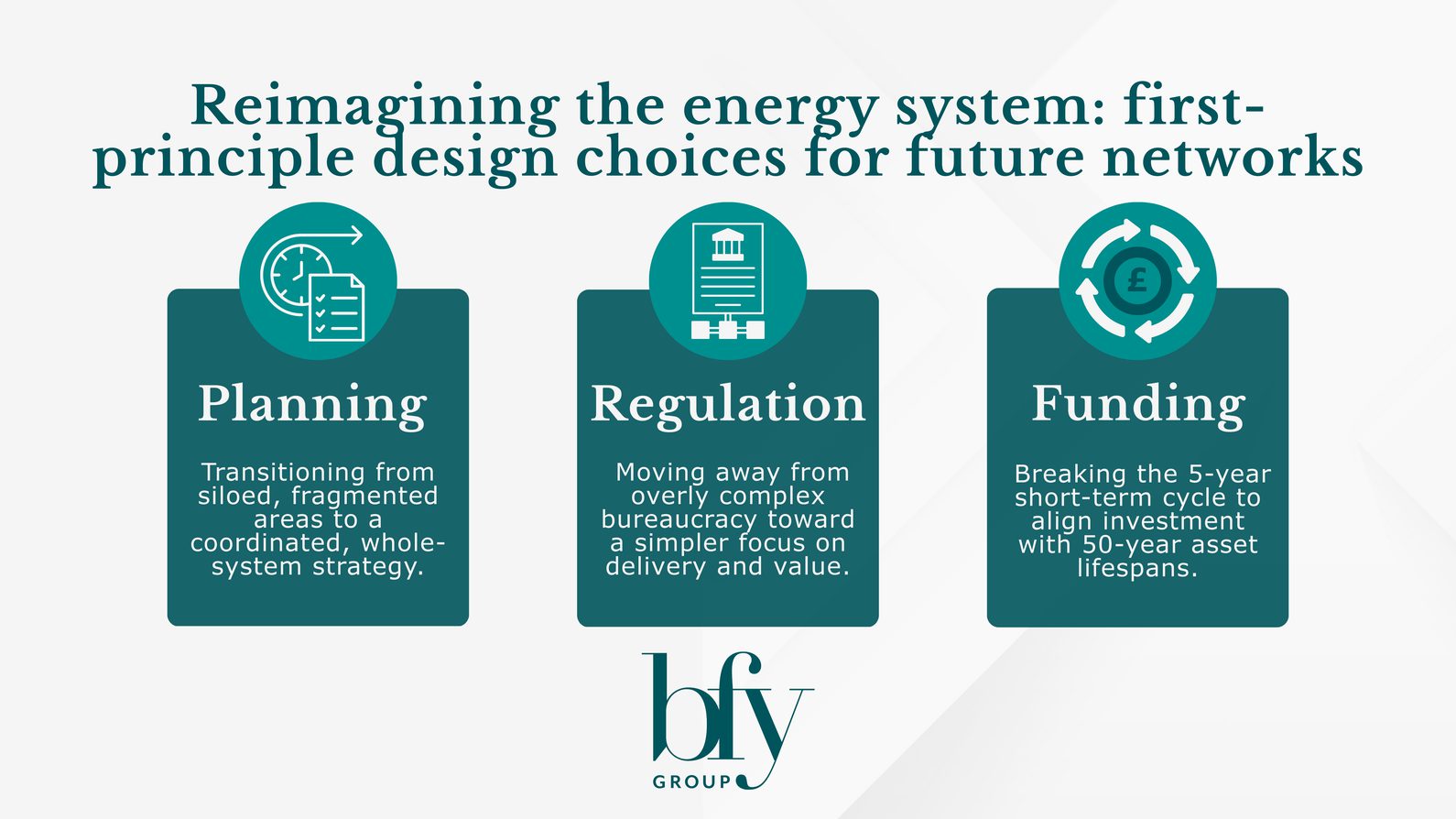
Planning: strategy over silos
Today's planning is fragmented by design. Distribution Network Operators (DNOs) plan within their licence area. Transmission Network Operators (TNOs) plan within theirs. The National Energy System Operator (NESO) functions at a different level again, and is still settling into its new mandate (and many would argue without truly ‘grasping the nettle’). Generators plan around a connections queue that had exceeded 750GW but has now subsided to a still unmanageable 450GW.
There's very little coordination between these bodies, and what coordination exists tends to happen after decisions have already been made. Regional energy strategic planning (RESP) and local area energy plans (LAEPs) are welcome steps, but they’re not yet weighty enough and don’t have sufficient government backing to radically change how the system works.
The alternative isn't complicated in principle. It's whole-system planning. Identifying what and where the need is and creating the route to delivery from generation through transmission to distribution. The critical and more challenging aspects are making things future-proof, building in sustainability and resilience, and driving growth with an eye on affordability.
With system-wide strategic planning and a locally delivered approach would by default create a more joined-up energy system. Generation siting decisions, network investment, storage, and demand management would have to be considered together. Then optimised against shared outcomes, involving local government and communities from the start. Preventing inefficiencies, encouraging affordability and even avoiding nimbyism. Therefore accelerating delivery of much needed infrastructure.
This is crucial for affordability, for net zero, and for the UK's ability to connect new generation at pace. Right now, the structure works against all three.
Regulation: smaller and simpler
Thirty years of privatisation has produced an overly complex regulatory framework. Some of that complexity was rightly earned, consumer protection, safety, financial resilience, for example. But some was inherited and accumulated to create a regulatory system that's slow, expensive to navigate, and disinclined to innovation.
With so many interested parties and so much intervention, bureaucracy has ballooned and become unwieldy. Case in point, Ofgem’s lack of support to boost network capacity, which resulted in that huge connections queue, over 750GW!
While Ofgem is under growing scrutiny, and Ofwat’s very existence is under threat, there's a genuine opportunity to review what regulation is for. Should regulation inflate and obfuscate, or make things simpler and smaller? Should it be omnipotent or should it focus on what matters? Delivery, safety (of supply, infrastructure, systems and customers), and value for money?
Which leads us neatly to the final area of improvement…
Funding: long-term gains
There's an unhelpful and unnecessary structural tension at the heart of the current model. Energy networks are built to last 50 years. They're funded in five-year cycles to fit with political and regulatory terms. Two timescales which are impossible to reconcile and still deliver value for money.
Ofgem's track record on anticipatory investment is the clearest example of this tension. Network companies were effectively prevented from investing ahead of confirmed demand. The long-term financial benefits of greater network capacity (lower constraint costs, better access to renewables, less exposure to fossil fuel price volatility) weren't properly accounted for during the calculations, instead focusing on short-term cost-cutting. And the current US inspired crisis in the Middle East will no doubt upset things further.
That miscalculation is now on the record.
And all this despite regular reports about the urgent need for more transmission capacity from NESO’s predecessor since the early 2010s.
Innovation and resilience stagnate, not because there isn’t the appetite, but because the system doesn’t adequately reward operator performance in those areas. If rewards or strategies are short-term, operations will only ever be short-term.
Fixing this requires more than adjusting price control timelines. We need to break the short-term cycle and focus on long-term investments with a funding mechanism aligned to asset life. Access to long-term capital will help provide enough flexibility to adapt as technology and policy evolve.
It also calls for careful consideration (and maybe some tough conversations) around whether consumer bills are the right vehicle to drive this kind of investment. Alternatively, we could look at general taxation, the investment model used for our rail network and highways.
What now?
None of these changes will happen overnight. We need to look beyond our own siloed remit and embrace whole-system thinking. This means collective leadership to fill the gaps from Ofgem, DESNZ and NESO – we just don’t see anyone willing to put their hand up and cry out “I’m Spartacus”. It falls on everyone in the network sector to focus on the consumer at the heart of the energy revolution, and design (and deliver) a system to sustain us all in a flexible, net zero future.
The organisations that will shape the next chapter of UK energy are those willing to engage with the structural questions now instead of simply reacting to the next consultation.
Ask yourself:
- Are your long-term investment decisions long-term, or are they shaped by five-year regulatory timelines?
- When did you last set objectives that were independent of the current price controls?
- What are you doing to support your organisation’s stability and growth; nurturing customer loyalty, developing processes, securing long-term investment, innovating?
- What would a whole-system view of your priorities look like, and how far is it from your current plan?
Finding the answers
There are no easy answers here. But it’s worth asking the right questions.
At BFY, we welcome the chance to explore the answers with you. We work with network leaders on strategy, regulatory engagement, and long-term investment planning. We challenge assumptions, ask even more difficult questions, and act as a critical friend to organisations thinking through decisions that matter.
Contact our team to discuss the opportunities for your organisation.


