


In this article we focus in on the second key enabler to redesigning the energy system: Breaking down the silos. In Part 2, we delved into Digitalisation at Scale as a key enabler.
In Part 1 of this series we noted that we spend a lot of time in the energy sector talking about improvement: faster connections; smarter grid management; more efficient price controls. In this part we proposed some design principles for future networks and offered some thinking for each.
The problem in numbers
Eight distinct national governance bodies owning around 10,000 pages of supply licence conditions and energy codes have conspired to create a grid connection queue of 450GW.
Thirty years of privatisation gave us DESNZ, Ofgem, NESO, Elexon, Smart DCC, RECCo, ElectraLink, and Great British Energy: each created to fill a gap. The cumulative effect is a relay race of hand-offs, where renewable energy projects wait years not because the technology isn’t ready, but because no single entity is empowered to cut through the red tape from planning consent to grid investment to market access.
Meanwhile, Ofgem’s headcount has more than doubled in a decade to over 2,100 staff; the regulatory rulebook has ballooned to unsustainable levels; and so the system is consuming its own energy just to keep running.
Back to first principles
What do we actually need to govern a modern net-zero energy system? Strip it back and a small set of core functions emerges: setting long-term policy direction; regulating monopoly behaviour and protecting consumers; planning and operating the system; running the market and data infrastructure; and mobilising capital for strategic assets the market won’t deliver alone. This, of course, remains true should a future Government decide to re-nationalise!
The current roster of eight institutions maps roughly to these functions, but with significant overlaps, artificial separations, and misaligned incentives baked in. Ofgem historically discouraged anticipatory network investment to keep immediate costs down, leaving renewables stuck behind grid constraints and passing an estimated £1.7-1.9 billion in constraint costs to consumers. Distribution and transmission planning have been siloed, with DNOs, TNOs, and NESO each focused on their own piece of the jigsaw, even as a renewables surge demands a whole-system view across our increasingly inter-connected ecosystem.
Three models worth debating
Each model below includes a concrete example of what it would change in the UK energy system today.
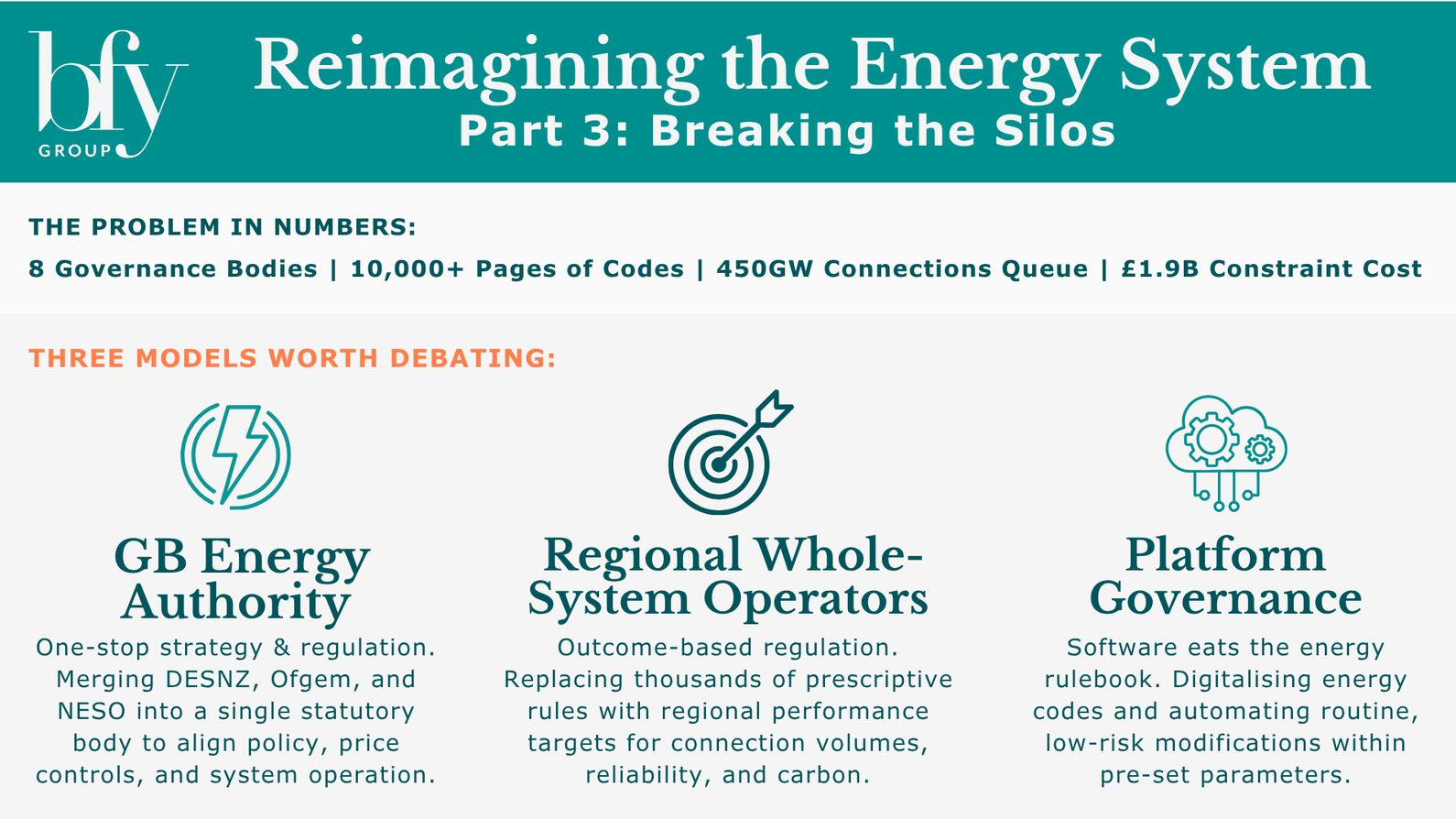
Model 1: GB Energy Authority - one-stop strategy and regulation
Merge DESNZ, Ofgem, and NESO into a single independent statutory body with end-to-end responsibility for net-zero delivery: setting price controls, sanctioning network investment, and overseeing markets all under one roof.
Take the current grid connection crisis. A project seeking to connect to the GB electricity system does not face a single accountable route from application to energisation. Depending on whether it connects at transmission or distribution level, the developer may deal primarily with NESO or with a DNO/IDNO, while network reinforcement is shaped by Transmission Owners or Distribution Network Operators, Ofgem’s price-control and code frameworks, and planning, consenting, land and supply-chain constraints. NESO now has a central role in transmission connections, whole-system planning and connections reform; Ofgem sets the regulatory and funding framework and approves major methodologies and price-control allowances; and network companies own and deliver the physical assets. The result is not simply three sequential approvals, but a multi-actor system in which responsibilities, incentives and timetables can misalign.
A GB Energy Authority would be a radical attempt to reduce those hand-offs by bringing strategic planning and funding authority closer together. Its potential advantage would be a clearer trade-off between cost, speed and system need. But it would need strong safeguards: independent scrutiny, consumer protection, transparent cost-benefit tests and clear separation between planning, approval and delivery functions to avoid replacing fragmentation with an unaccountable monopoly decision-maker.
Model 2: Regional whole-system operators and outcome-based regulation
Create regional operators that combine electricity distribution networks with portions of the national system operator function, managed to clear outcome targets - volume of connections, reliability standards, carbon intensity - rather than thousands of prescriptive rules.
Consider constraint management in Scotland, where high renewable output is frequently constrained because transmission capacity across key north–south boundaries cannot always move power to demand centres fast enough. That has material consumer costs: NESO must often reduce generation behind a constraint and procure replacement energy elsewhere, with constraint and balancing costs ultimately recovered through system charges. Today, reducing those costs is not the responsibility of a single actor. NESO manages real-time balancing, constraint services and strategic network planning; SSEN Transmission, SP Transmission and, at the Scotland–England interface, National Grid Electricity Transmission own and deliver the relevant network assets; Ofgem sets the funding, incentive and approval framework through RIIO, ASTI and related mechanisms; and code/market governance shapes how flexibility, settlement and balancing reforms are implemented.
The result is not that Ofgem approves every operational decision, but that planning, funding, market design, consenting and delivery sit across different institutions and timescales. A more outcome-based regional model for Scotland could, in principle, sharpen accountability by setting a clear objective — for example, reducing curtailment and associated consumer costs over a defined period — and giving the responsible body greater freedom to combine network reinforcement, intertrip schemes, local flexibility, storage, demand siting and market procurement. But it would need safeguards: GB-wide system optimisation, transparent cost-benefit tests, consumer-protection oversight, clear treatment of devolved consenting powers, and protections against overbuilding or shifting costs elsewhere. Ofgem’s role would be better framed as setting the consumer-value envelope and enforcing outcomes, rather than approving each individual operational or investment choice.
Model 3: Platform governance - software eats the energy system
Digitalise all market codes and operating rules into a single national energy data and market platform. Routine regulatory approvals and code modifications are automated within pre-set parameters; human regulators focus on oversight and edge cases.
Energy code modifications can take months, and, for material changes, sometimes more than a year from proposal to implementation. Under the Balancing and Settlement Code, a modification that changes the Code itself is usually assessed by the BSC Panel and, in many cases, a workgroup; the process can involve industry consultation, impact assessment, legal drafting, Panel recommendation, Ofgem decision and then implementation through scheduled release windows. Elexon’s own guidance says BSC Modifications typically take six to eight months to a final decision, with further implementation lead time, while more complex changes can take well over a year.
Flexibility-related reforms illustrate both the need for speed and the reason governance exists. Recent BSC changes around independent aggregators, Virtual Trading Parties and compensation arrangements have raised live issues about consumer impacts, market efficiency, gaming risk and unintended consequences. Those are not changes that can simply be waved through. But the current fragmented code landscape can make even well-understood changes slower and harder to coordinate, especially where dependencies cut across codes, data items or central systems.
A unified digital code-change platform would not remove regulatory oversight. Its value would be to standardise submission, triage, dependency mapping, legal-text version control, impact templates and implementation planning across codes. Low-risk, repeatable, pre-authorised changes could be routed through a fast digital process, while material or novel changes would still receive human scrutiny from code managers, stakeholder forums and Ofgem where required. The objective should be to reserve scarce expert attention for changes that genuinely affect consumers, competition, settlement cashflows or system security, not to automate away the judgement that complex market-rule changes require.
These aren’t prescriptions but provocations. Each involves genuine trade-offs on accountability, investor confidence, and implementation complexity. But the water sector has already shown us what bold consolidation can look like: the government’s 2025 plan to abolish Ofwat and merge four agencies into one (although still to be actioned) demonstrates that the UK is willing to act when the status quo stops working. The energy sector can’t afford to wait for a similar crisis moment.
What can be done now
Radical reform is a 10–15 year journey, but three near-term moves would plant the seeds: cross-functional Net Zero delivery teams that bring DESNZ, Ofgem, NESO, and industry to one table; accelerated code consolidation under the Energy Act 2023 powers; and a pilot of outcome-based regulation in a sandbox region - waive the prescriptive rules, set clear performance targets, and measure what actually happens.
The goal isn’t reorganisation for its own sake. It’s refocusing everyone - regulator, system operator, network company, market participant - on a single mission: a clean, reliable, affordable energy system, delivered on time. The sacred cows of governance, the inviolate independence of the regulator, the multiplicity of code panels, should not stand in the way of that mission.
The UK has a narrow window to build the infrastructure Net Zero requires. Every year spent navigating the current governance architecture is a year that window shrinks. We’re not claiming these models are the answer; but we are claiming that the question of how we govern the energy system is at least as important as what technology we deploy or how much capital we raise. If you think we’ve got it wrong, tell us. If you think we’ve got it right, tell someone who needs to hear it.