


Continuous improvement is often treated as an operational discipline. In our experience, it's one of the defining characteristics of high-performing leaders.
In the first article in this series, we explored why leadership development creates greater value when it starts with the business problems an organisation is trying to solve, rather than a predefined training programme. When we looked across the programmes we've delivered, one capability consistently stood out as having a disproportionate impact on operational performance: the ability to think like a continuous improvement leader.
That wasn't because every participant worked in an operational excellence role or had previous experience of continuous improvement. Many didn't. What they shared was responsibility for delivering results through other people. Whether they led customer operations, support functions or frontline teams, the leaders who created the biggest improvements were those who learnt to approach problems differently.
Across one 32-week programme involving more than 400 frontline, middle and senior leaders, that shift in thinking contributed to a 38-45% improvement in measured leadership capability, a 58% increase in weekly debt resolution and a 20% increase in operational capacity. Those improvements came from helping leaders understand how to improve the way work was being done in the first place.
Continuous improvement belongs in leadership
Many organisations still associate continuous improvement with specialist operational teams, Lean practitioners or transformation programmes. Those functions undoubtedly have an important role, but treating continuous improvement as a specialist discipline can unintentionally limit its impact.
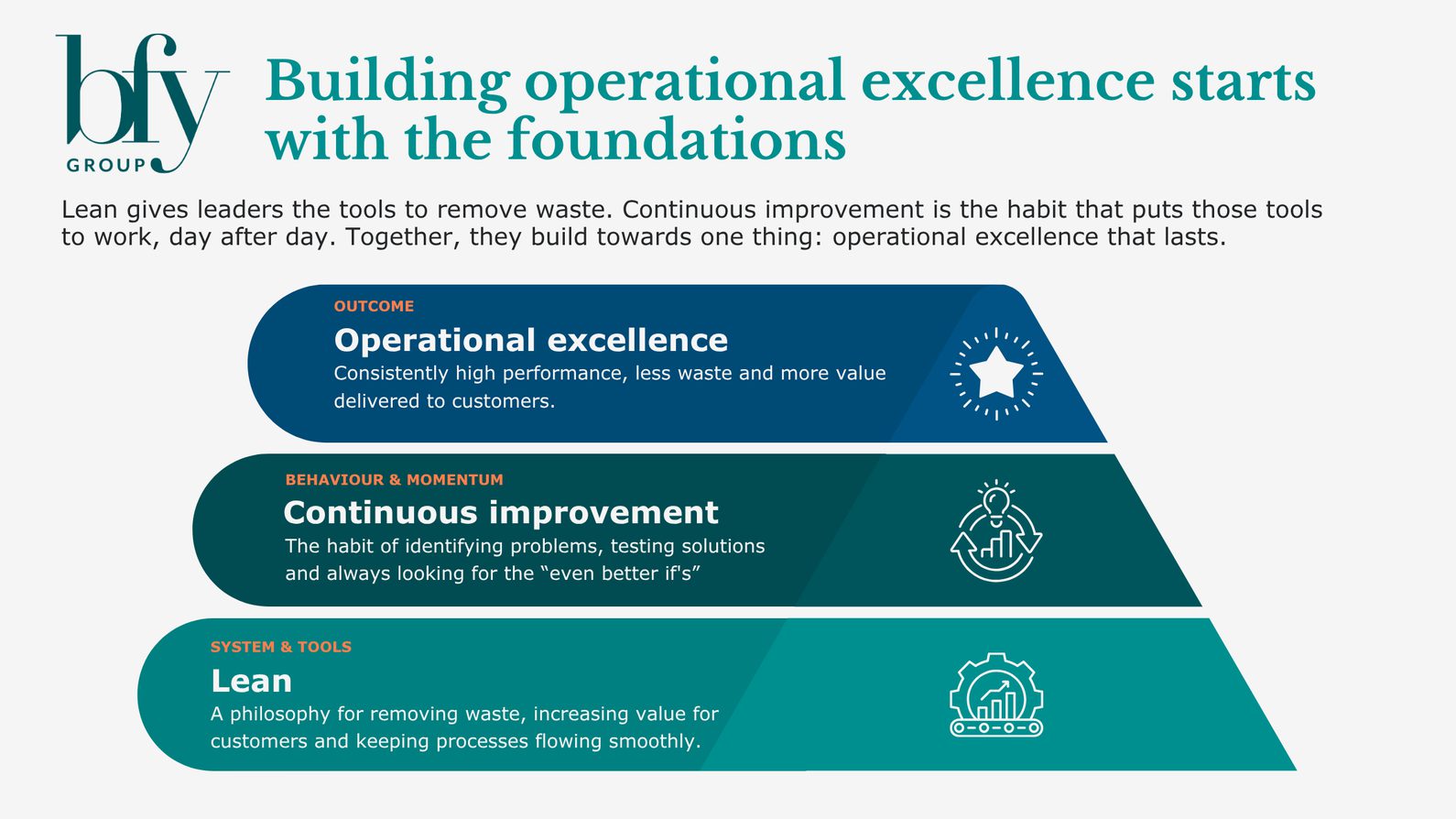
It helps to separate the three:
- Lean is the system: a set of tools for removing waste and keeping work flowing.
- Operational excellence is the outcome: consistently high performance, less waste, more value.
- Continuous improvement sits between the two. It's the behaviour and the momentum that keeps turning one into the other.
Every leader influences how effectively work is delivered. They're constantly making decisions that shape how problems are discussed, how priorities are set, where effort is focused and how their teams respond when performance falls short. Every one of those decisions has the potential to improve performance or allow existing issues to continue.
For that reason, we see continuous improvement as a leadership capability before anything else. Leaders don't need to become improvement specialists, but they do need the confidence and structure to identify problems, understand what's really causing them and lead their teams towards better ways of working. Those capabilities become increasingly important as organisations face growing pressure to improve performance while managing change, controlling costs and meeting rising customer expectations.
The biggest shift is often how leaders think about problems
One of the most common observations we make during diagnostics is that leaders are highly committed and technically capable, but many have never been taught a structured approach to solving operational problems.
That means discussions often focus on symptoms rather than causes. Teams work around recurring issues instead of removing them. Additional resource is requested before understanding whether work could be simplified, redesigned or prevented altogether. Improvement opportunities are identified but struggle to progress because there’s no clear route from recognising an issue to delivering sustainable change.
Helping leaders think differently relies on practical ways of breaking problems down, asking better questions and making decisions based on evidence rather than assumption. That shift sounds straightforward, but it fundamentally changes the quality of the conversations leaders have with their teams and the decisions that follow.
Practical tools create practical improvements
Developing a continuous improvement mindset gives leaders three things: the ability to spot where work isn't adding value, the skills to solve problems properly and the practical tools to act on what they find. All of these they can apply immediately in the context of their own operation.
Throughout our programmes, leaders develop structured approaches to identifying root causes rather than treating symptoms, assessing the commercial value of improvement opportunities and turning ideas into realistic delivery plans. They also learn how to embed improvements so that better ways of working continue long after the initial intervention.
Together, these techniques provide a common language for improvement. Leaders become more confident in diagnosing operational challenges, prioritising where effort will create the greatest value and leading change in a way that can be sustained, rather than relying solely on experience or instinct. Without these skills, leaders often have to lean on support functions to fix problems, leaving issues sitting in a backlog, waiting to be prioritised. With them, leaders can own and solve problems directly, creating impact sooner and increasing performance improvements without that dependency.
Importantly, these aren't skills reserved for large transformation programmes. They become part of everyday leadership, influencing performance conversations, team meetings, planning sessions and operational reviews. Over time, leaders become more proactive in identifying opportunities for improvement instead of waiting for problems to escalate.
Small changes often unlock significant value
The impact of that approach is often much greater than many organisations expect.
During one programme, a leader was managing a growing operational backlog that appeared to require significant additional resource to resolve. By applying the structured problem-solving techniques introduced through the programme, the team analysed the work in more detail and challenged long-held assumptions about what actually needed to be completed.
In our experience, the biggest gains often come from asking what's generating the work in the first place. That question led the leader to remove, automate or reprioritise around 50-60% of the inflow and backlog, though it took some bold decisions about what genuinely needed doing. No major technology programme had been introduced and the operating model remained largely unchanged. The team was then sized against a realistic picture of demand. The improvement came from a leader applying a more structured way of understanding the problem and helping the team think differently about the solution.
Examples like this illustrate why continuous improvement should never be viewed simply as a collection of operational tools. The greatest value comes from changing the way leaders think, because that influences hundreds of decisions long after a programme has finished.
Building capability that lasts
The organisations that achieve lasting operational improvement rarely rely on occasional improvement projects to drive change. Instead, they develop leaders who continually question how work can be made simpler, more effective and more valuable for customers and the business.
That capability compounds over time. Leaders become more confident in challenging existing processes, while teams become more comfortable identifying waste and suggesting improvements. There's often a visible shift in energy too. When leaders solve a problem with their team, rather than for them, the fix itself is only part of the win, the bigger one is proof that things can actually change. We've seen that feeling spark real appetite: teams who've experienced the shift from stuck to solved want to find the next problem, and move faster each time they do. Small operational gains begin to accumulate into measurable business benefits over time. Improvement becomes part of normal leadership practice instead of another project that sits alongside day-to-day operations.
This was one of the strongest lessons from our own experience. The programme delivered significant improvements in leadership capability, customer outcomes and operational performance, but those results were underpinned by something much simpler.
Leaders became better equipped to identify problems, solve them in a structured way and sustain the improvements they introduced. As those behaviours became more consistent, the operational improvements followed.
Looking ahead
Continuous improvement helps leaders identify better ways of working, but identifying opportunities is only part of the challenge. Organisations also need leaders who can translate those improvements into clear priorities, aligned teams and consistent delivery.
In the final article in this series, we'll explore why better objective execution starts with better leadership, and how stronger leadership behaviours help organisations turn strategic ambition into measurable day-to-day performance.
If you're thinking about how leadership development could strengthen continuous improvement capability across your organisation, we'd be happy to share more about the approach and lessons from our experience. Get in touch with Kev Brown.