

Sales teams that deliver predictable, repeatable results don't happen by chance. They're built on a framework, not on a handful of exceptional individuals.
Most energy sales teams already have a lot of what it takes: strong market knowledge, good customer relationships, real experience. Yet look across a whole team and the picture is often uneven, with opportunities handled differently, pipelines moving at different speeds, and performance varying more than it should.
That's rarely a question of capability. More often, it's a question of structure, and it's one energy sales teams can solve.
This article looks at what that framework can look like in practice, the behaviours it needs to reinforce, and how leaders can use it to build greater consistency across their sales team.
Why structure matters more than ever
In small business, residential, and mid-market energy sales, the environment is fast-moving, competitive, and heavily relationship driven.
But it’s also increasingly complex. Buyers are more informed, pricing pressure is constant, and differentiation is harder than ever.
Without a framework, sales become reactive instead of repeatable. Activity turns inconsistent, pipelines become unpredictable, and performance starts to depend on a handful of individuals. None of that scales.
What a Structured Sales Framework Actually Means
A structured framework gives salespeople clarity, rhythm, and discipline, so every opportunity is handled with intent. It doesn't turn them into robots.
A strong framework enhances performance rather than restricting it.
At its core, it means:
- Pipeline management - Clear visibility, prioritisation, and momentum across every stage. All opportunities are just that, an opportunity.
- Consistent voice contact - Not hiding behind emails. Real conversations are still what drive decisions
- Disciplined follow-up - Opportunities don’t go cold through neglect
- Effective objection handling - Addressing concerns with confidence, not avoidance
- Strong questioning techniques – Understanding the customer needs and priorities before providing a tailored solution
- Account manager behaviours - Ownership, accountability, and long-term relationship building
None of this is complicated. Doing it consistently, across a whole team, is what's hard.
The Commercial Impact
This is where structure moves from “nice to have” to commercially critical.
A well-run framework changes outcomes, not just activity levels.
You start to see:
- Higher acquisition
- Improved customer retention
- Revenue per hour increase, at companies we’ve previously worked with we’ve seen increases of 45%-57%
- Shorter sales cycles
- Increased efficiency, at companies we’ve previously worked with we’ve seen this increase up to 45%-55%
- More predictable commercial forecast
- Stronger margin control
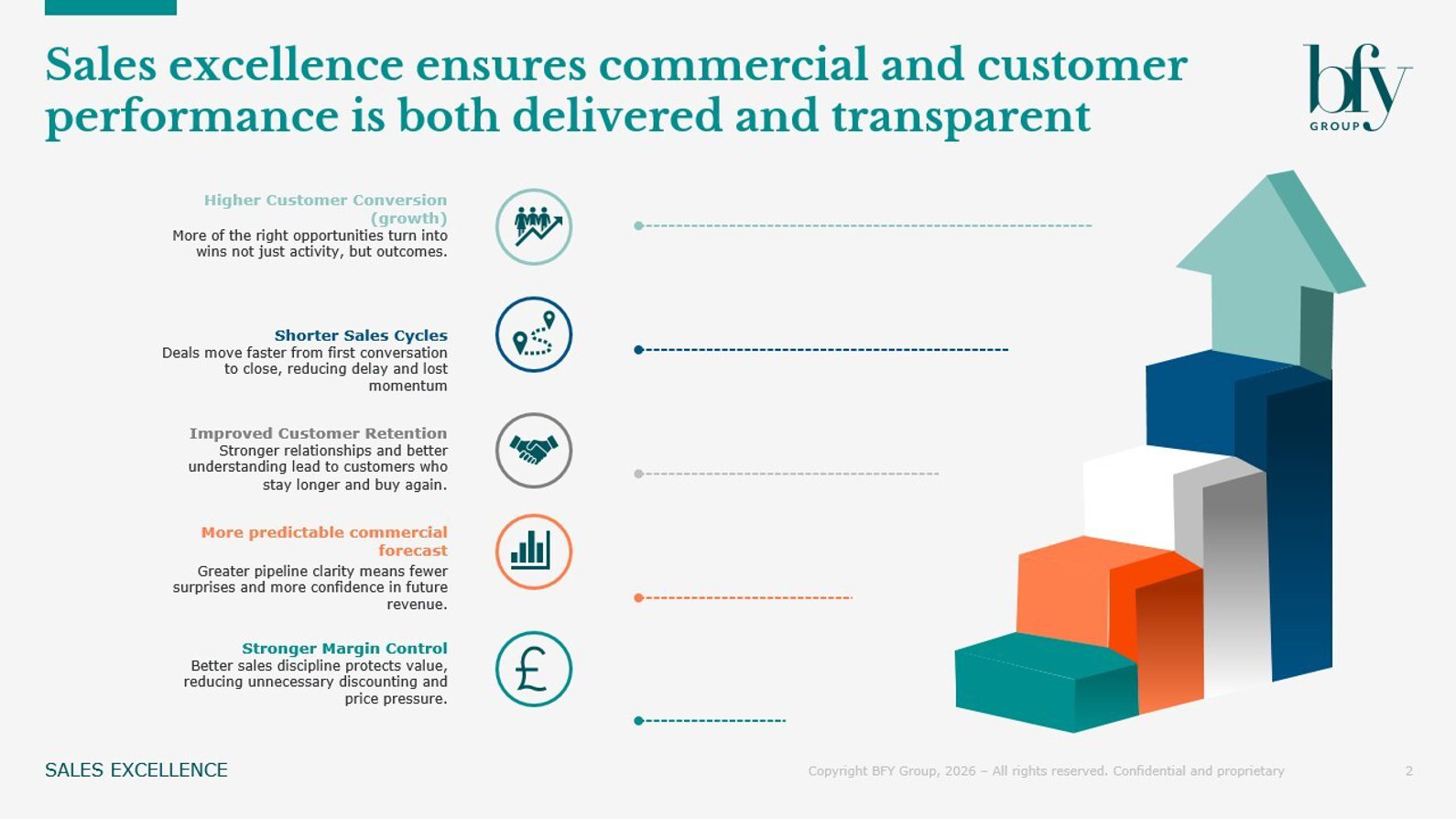
That's the pattern behind every one of these gains: teams that repeat and measure their approach outperform teams that don't.
The Coaching Advantage
One of the biggest shifts happens behind the scenes, within leadership.
Without structure, coaching tends to be vague: “Make more calls.” “Push harder on objections.”
With structure, coaching becomes targeted, measurable, and far more effective.
Leaders can:
- Review pipeline quality, not just size
- Listen to call techniques and questioning depth
- Identify specific skill gaps
- Build confidence through repetition
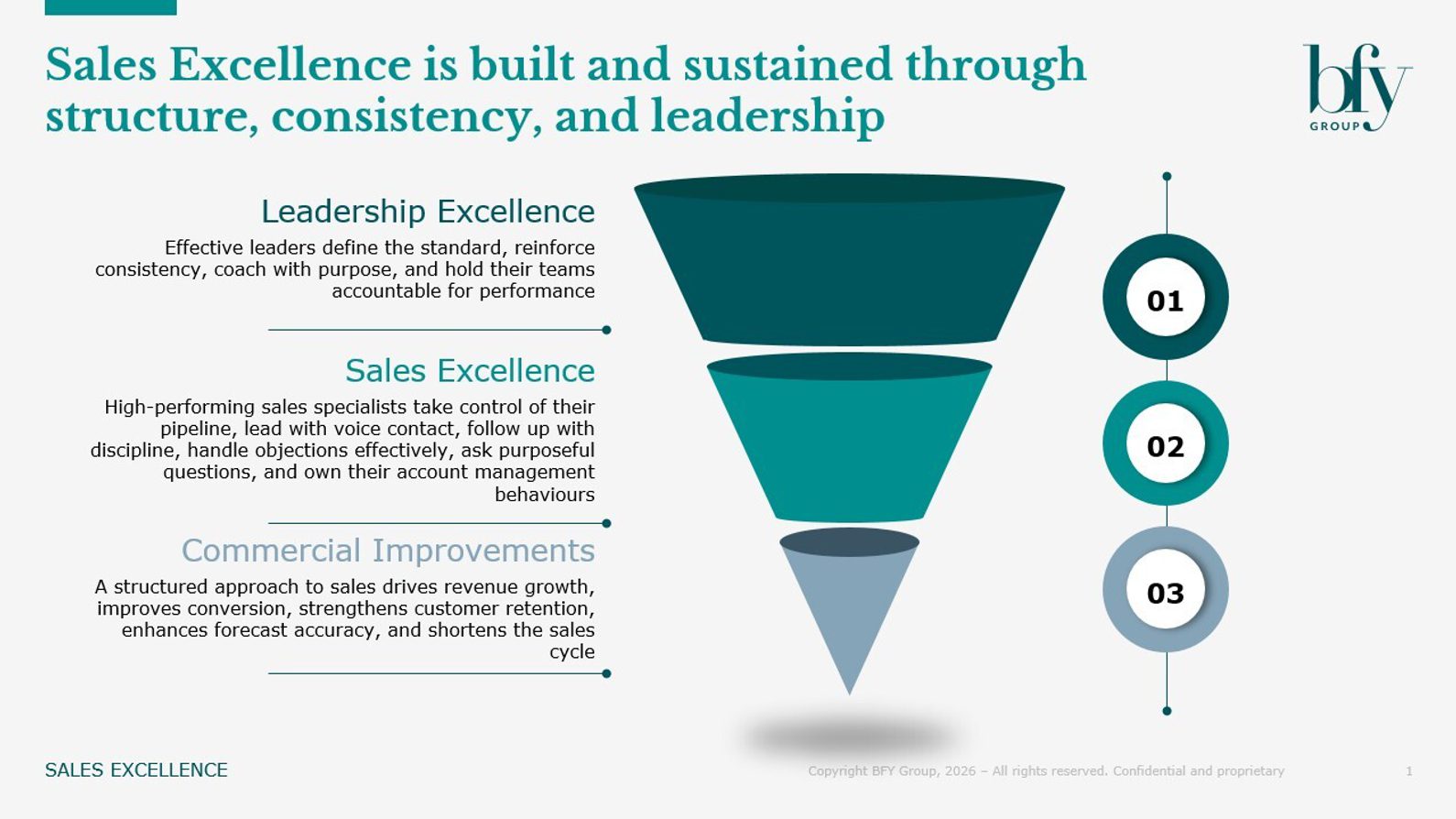
This is where frameworks like Leadership Excellence really come into their own, turning coaching from opinion into something far more objective and impactful.
What Great Sales Teams Have in Common
The best-performing teams are genuinely aligned. They work from a clear, consistent sales vision and process, with agreed standards of activity and behaviour. They run regular, structured pipeline reviews, stay open to feedback and coaching, and keep sales and leadership pulling in the same direction. The result is consistency.
This pattern isn't unique to energy. We see the same discipline at play in water providers managing compliance and infrastructure investment, in utilities balancing resilience, cost and decarbonisation, and in other regulated industries where buying decisions are high-stakes and slow-moving. The specifics change, but the underlying discipline doesn't.
What’s at Risk Without It
The absence of structure doesn’t stay hidden for long.
Over time, it shows up in missed revenue targets, poor forecasting accuracy, missed opportunities to maximise value, inconsistent customer experience, and low team confidence, with growth increasingly dependent on a handful of top performers. Left unchecked, growth slows, or stalls completely.
The Leadership Factor: Where It’s Reinforced
Sales excellence depends on leadership excellence. Frameworks rely on people to sustain them, and leaders set the tone, the expectations, and the consistency. Strong leadership keeps the framework in active use, upholds standards across the team, makes coaching part of the culture, and keeps performance conversations honest and constructive.
From my experience working as a Sales Manager
In our experience, the difference is always obvious. Teams without structure work hard but often feel stuck. They don’t always understand why their effort isn’t translating into results.
Teams with structure work with direction and improve faster. The biggest shift comes from consistency, not effort, and that consistency is what changes behaviour.
Once a framework is in place:
- Conversations improve
- Pipelines strengthen
- Confidence grows
- Results follow
Final Thought
Sales excellence comes down to doing the right things, consistently.
Start simple:
Build your framework
- Reinforce it through leadership
- Coach against it daily
- Get the structure right and it builds momentum, not just process.
If you'd like to explore how Sales Excellence can help elevate your team's performance, please feel free to reach out to Louise.
Louise Willumsen
Manager
Louise helps clients to achieve Operational Excellence, and specialises in driving continuous improvement through sales and retention performance, and process efficiency.
View Profile