

Water companies have £104bn to spend in AMP8 and too few people ready to deliver it. Nearly a quarter of water engineers are expected to retire within five years, while energy, transport and defence compete for the people who could replace them.
If you lead delivery, commercial or people teams in water, you’re already working around that gap. At the Institute of Water’s Annual Conference, I debated what’s driving it and what the sector can do about it. These are my reflections from that panel, and the four things I think will help.
I’ve spent 20 years in UK water, working for a utility, a kit supplier, a contractor and consultancies. Each of those seats has shown me the same picture: growth arriving faster than the people needed to deliver it.
In September, I joined Barry Hayward, Chief Commercial Officer at South Staffordshire Plc, Fatima Naeem of Aqua Consultants and Adam Cave, founder of recruitment firm Murray McIntosh, for The Great Water Workforce Debate at the Institute of Water’s Annual Conference. Our host, Nicci Russell, CEO of Waterwise, asked whether the sector faces a shortage, a perception problem or a culture problem. We all answered “all three”, but disagreed on which comes first, and that disagreement points to what we should do next.
My answer was shortage, and that we made it partly ourselves. AMP8 brought £104bn of investment into water and sewerage infrastructure in England & Wales, the sector’s biggest ever five-year programme, and we asked for every penny. After years of underinvestment, ageing assets and public anger over sewage, that money was necessary and overdue. The workforce to spend it well wasn’t ready. That shortage then feeds the other two problems: people don’t join an industry that looks stretched, and they don’t stay somewhere that feels like constant firefighting.
The numbers back this up. Water UK and government have committed to recruiting 50,000 people into the sector by 2030, including 5,000 apprentices. CIWEM puts the gap at 43,700 additional workers by 2030, a 36% increase on today’s workforce, drawing on Energy & Utility Skills data. The Independent Water Commission, led by Sir Jon Cunliffe, found that 23% of water engineers are expected to retire within five years. Murray McIntosh’s own 2025 Water Industry Labour Report found 66% of water engineers were considering a move to another sector. Adam added that averages hide where the gaps bite hardest: engineering, project delivery and commercial roles, where energy, transport and defence compete for the same people.
Barry framed it differently. For him, the bigger challenge is workforce proposition rather than capacity, and he gave the line of the day: “We cannot recruit 50,000 experienced water professionals because they do not exist.” Adam ranked the three: shortage is the immediate challenge, perception is the root of future ones, and culture decides which organisations win the talent that is available. He also warned that the old habit of compressing delivery into the final years of a regulatory cycle won’t hold this time, and AMP8’s slow start makes that risk more real. Put together, the conclusion is uncomfortable. We can’t hire our way out of this from our own talent pool. We have to grow people, attract them from elsewhere and keep the ones we have.
Four things help
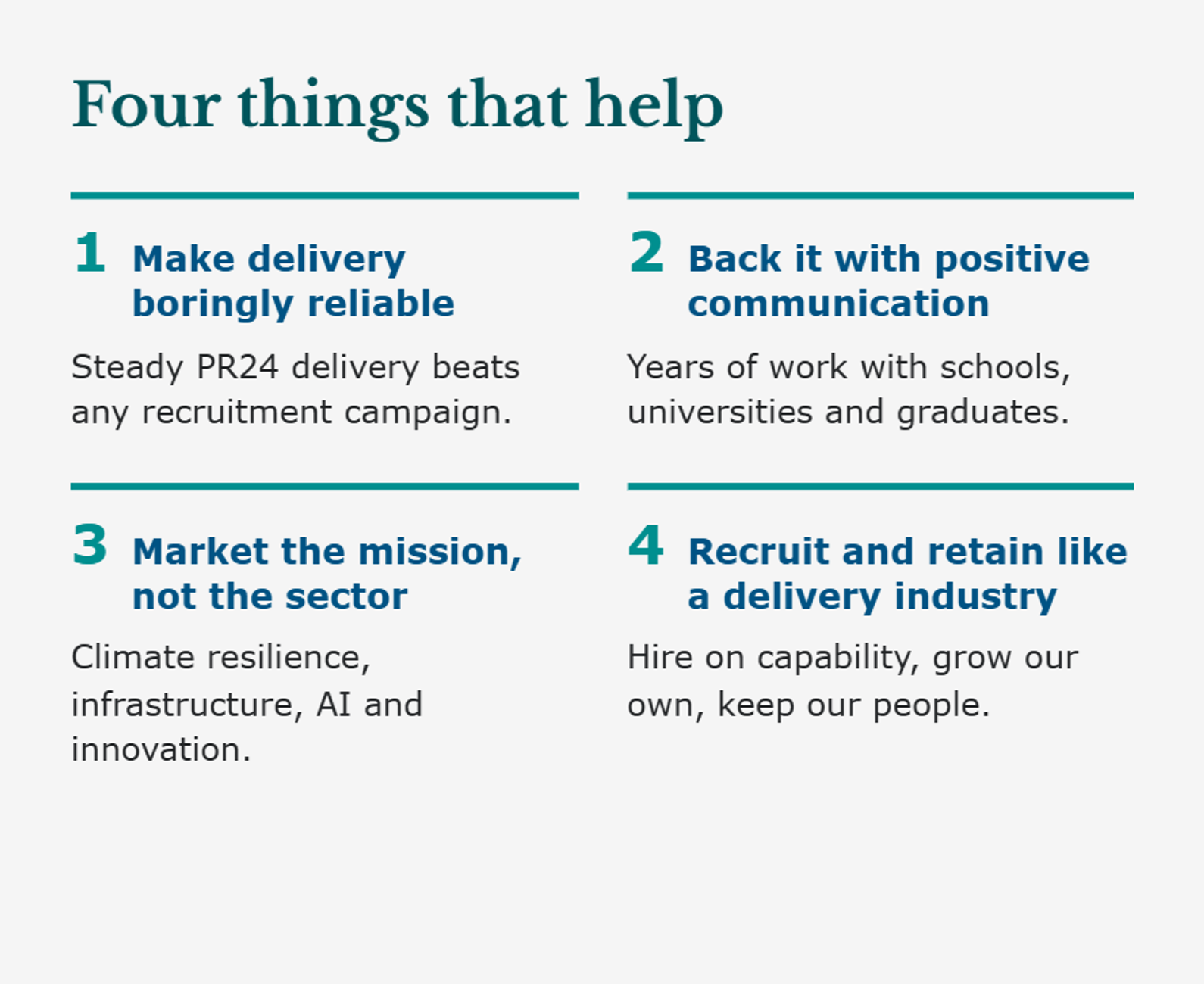
First, delivery has to become boringly reliable. Every burst main, missed leakage target or sewage headline is free advertising against the sector, just as we’re trying to recruit into it. Steady, predictable delivery of the commitments made in PR24 will do more for recruitment than any campaign, because it removes the reason talented people give for staying away.
Second, that delivery needs consistent, positive communication behind it. Water tends to make the news only when something has gone wrong. Utilities, contractors and consultancies need to work together to put the scale of what we’re building in front of the graduates, career changers and apprentices we want to reach. As Adam said, one campaign won’t shift perception. It takes years of work with schools, universities and early-career professionals, and it only works if we treat talent as an industry issue rather than a company one.
Third, and the one I feel most strongly about: we need to stop describing these as water sector jobs. Few people grow up wanting to work in water. Plenty grow up wanting to work on climate resilience, critical national infrastructure, AI and innovation, and that’s what a modern water career offers. Barry made the same case from the panel. I work with two organisations outside the water sector which back this point up: every sector is fighting for talent. Water isn’t uniquely unattractive. It just isn’t making its case. We should market the mission, not the sector, because that’s what wins back the graduates that we lose to renewables and nuclear.
Fourth, we need to recruit and retain like the delivery industry we are. That means hiring from related sectors on capability and attitude, rather than insisting on direct sector experience. It means using contractors and interim expertise strategically, and taking a commercially realistic approach to the off-payroll working rules (IR35), which many organisations apply so cautiously that they shut out expertise. It means growing our own through apprenticeships, schools engagement and career changers. And it means keeping people, with leaders who invest in their teams, clear career paths and flexibility.
What doesn’t help
Inconsistent delivery hands the press a ready-made story, and every bad story makes recruitment harder. Layered onto that is real uncertainty about the industry’s future shape. Since our panel, the Prime Minister has announced a strengthened Water Bill that would remove the statutory limits on government ownership of water companies and give mayors new powers to hold them to account, with more detail promised in the government’s 10-year plan for Britain. I’m not going to argue for or against an ownership model. But few people commit to a 20-year career in an industry that might be restructured beneath them. Whatever form the reforms take, clarity and continuity for the people delivering AMP8 should be part of the design.
There is good news. For years, the sector’s answer to structured pipelines and training beyond immediate need was that there was no budget. The AMP8 settlement, the Water Skills Pledge and the 50,000 commitment remove that excuse. Adam closed the panel on a similar note: when candidates understand the impact they can have in water, they’re usually interested.
This is largely a self-made problem, which means it’s within our control to fix. We can’t wait for government, a review or a 10-year plan to fix it for us. Every utility, contractor, supplier and consultancy in this sector has spent the last five years arguing for more investment. We need to spend the next five proving we can build the people to deliver it. We built the funding case. Now let’s build the people.
Most of the people who’ll deliver AMP8 are already in the sector. If you’re looking to build a culture that engages and keeps them, I’d be glad to talk it through. We’re already helping utilities give their managers the skills to develop their teams and keep delivery steady under pressure.
Neal Edmondson
Client Director
Neal leads our Water Networks team with a focus on helping clients meet increased customer expectations and regulator requirements.
View Profile