


The first tranche of suppliers entering Market-Wide Half-Hourly Settlement (MHHS) go-live represents a significant milestone.
For suppliers that have already transitioned, there’s a sense of measured accomplishment: “We have reached this point, yet substantial work remains.” For those preparing for later tranches, the mood is less celebratory and more characterised by anticipation, and a growing recognition that the transition has moved beyond theory. MHHS is now an operational reality.
And for everyone, regardless of tranche, the most immediate challenge now emerging is reverse migration. As customers switch from MHHS-enabled suppliers back to those still operating under legacy arrangements, the receiving suppliers must bring these customers back into traditional processes smoothly and consistently.
This blog focuses on why reverse migrations carry real operational and customer-experience risks, what early adopters are already seeing, and what suppliers can do now to reduce disruption.
Everyone is already feeling the impact of MHHS
A consistent theme emerging across the industry is a collective acknowledgement that, regardless of go-live status, all suppliers are now exposed to the consequences of early adoption.
Customer behaviour does not align with programme timelines, and as early suppliers begin half-hourly settlement, the market is already seeing the operational impact of the first transitions.
Reverse migration: The first real test of market readiness
Reverse migrations have rapidly become one of the most immediate and consequential dynamics triggered by the first tranche. As customers switch from MHHS-enabled suppliers back to those still operating under legacy arrangements, the receiving suppliers must be able to manage customers returning from half-hourly settlement into traditional processes.
This introduces several complexities:
- Mixed-state portfolios: Suppliers must operate seamlessly across MHHS and non-MHHS environments simultaneously, often without full end-to-end automation in place.
- Data integrity requirements: Ensuring accurate, timely, and reconciled data becomes more challenging when customers move backward in the settlement process.
- Process discipline: Reverse migrations expose any weaknesses in operational readiness, particularly where suppliers have underinvested in interim-state processes.
- Customer experience management: Without clear, consistent handling of reverse migrations, customers may encounter fragmented journeys, creating dissatisfaction at a time when market confidence is critical.
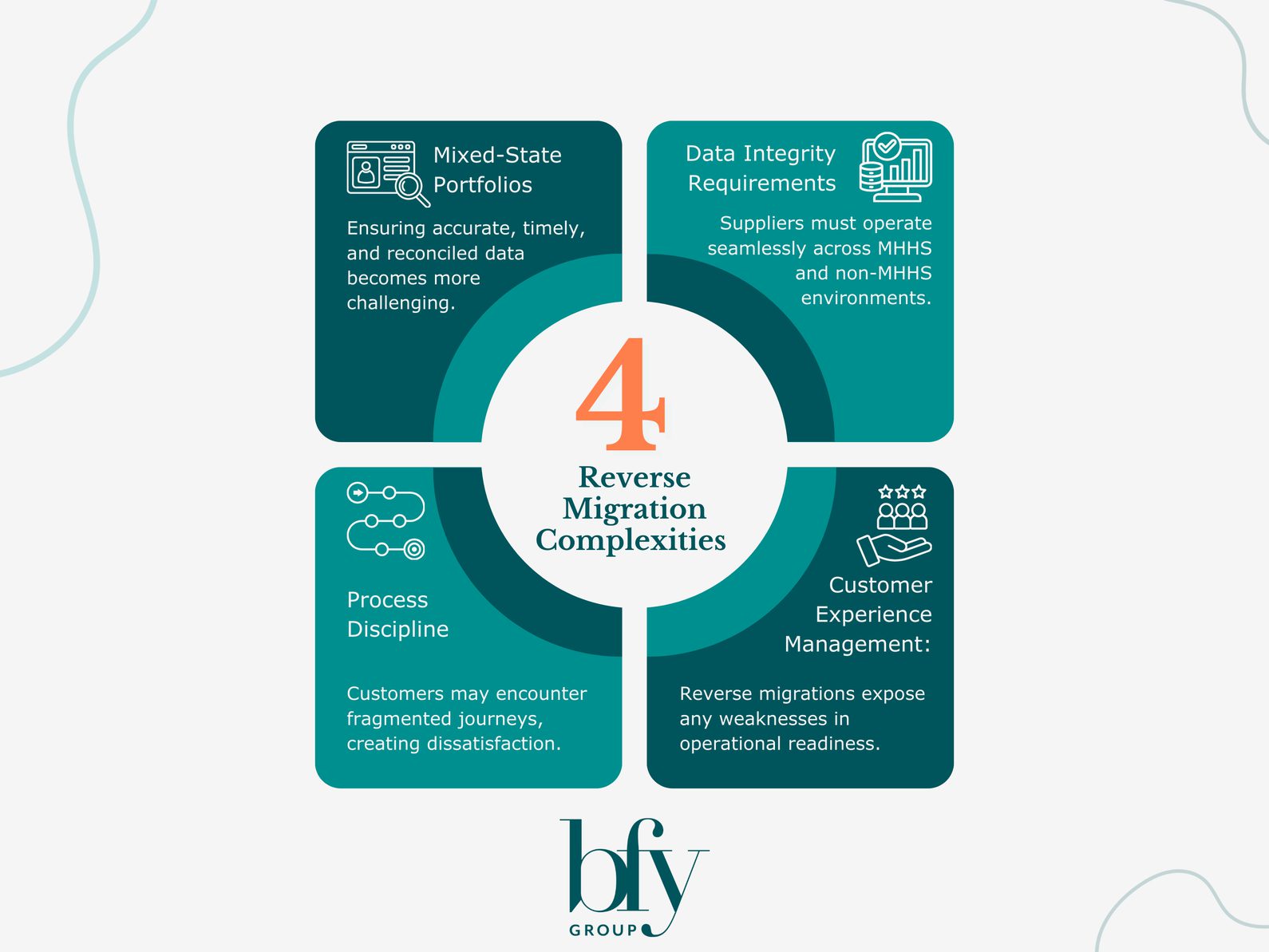
Reverse migrations are no longer a niche scenario or a late-stage programme requirement, they are the first live test of the industry’s collective MHHS readiness.
Readiness gaps as operational risks
At this point, any gaps in readiness translate directly into operational risk.
The areas where suppliers are most exposed include:
- Mixed-state process readiness: Suppliers must be able to operate MHHS and non-MHHS processes in parallel, with reliable handoffs between the two.
- Data exchange and validation: Data flows, validation logic and reconciliation need to work consistently, or reverse migrations will immediately introduce errors.
- Customer journey continuity: Customer journeys must remain coherent before, during and after a reverse migration - any break risks confusion, complaints and billing issues.
- End-to-end testing: Suppliers need fully tested scenarios that cover the entire journey, not just the MHHS elements. Reverse migrations quickly expose any untested steps.
While early adopters encounter these challenges first, the operational impacts extend across the whole market.
Commercial considerations
Suppliers that have successfully migrated may benefit from being able to offer more competitive tariffs, particularly where MHHS enables a stronger Time-of-Use product offering.
This pressure may be especially acute in the SME market, where TPIs and brokers are highly price-sensitive and even small pricing variances can weaken competitiveness.
There is also a risk that migrated suppliers will take additional steps to retain customers they have already migrated, reflecting the investment made in migration and data cleansing, as well as the potentially improved margins they can now realise.
Have you factored in the possibility of gaining fewer customers prior to migration, due to a less competitive tariff and product offering?
The mood: Cautious and conscious
The prevailing sentiment surrounding this initial tranche might best be described as “cautious progress.” Suppliers express satisfaction in reaching go-live while remaining acutely aware of the fragility of the transition. The true test lies not in the go-live moment itself, but in navigating the unpredictable, customer-driven switching scenarios that follow.
Lessons for upcoming tranches
As subsequent tranches approach their own implementation phases, leaders should consider this first wave as an early indicator, integration readiness is essential well before formal cutover. Reverse migration capability is no longer a peripheral consideration - it represents the first substantive MHHS interaction point for many suppliers.
The programme is now fully under way. Whether a supplier is live or awaiting its allocated tranche, the effects are already being felt across the market.
How ready do you feel for reverse migrations and go-live?
In a recent MHHS readiness assessment, we helped an energy supplier to identify a £75m annual settlement risk, addressed through tailored, practical recommendations.
For more information on how we can support your MHHS readiness, contact Jon Vincent.