


Engagement is a critical enabler of MHHS success. With around 59% of core operational processes typically affected, the programme represents one of the most significant operating model shifts suppliers have faced.
Based on our analysis, the scale of change extends far beyond systems: 80% of the workforce will require upskilling or training, with 30% of teams experiencing a fundamental shift in their day-to-day ways of working. Technical readiness and regulatory compliance are essential foundations, but on their own, they don't guarantee a successful transition.
Generic or surface-level engagement will not protect operational performance, pricing integrity, or customer confidence. What we consistently see across the industry is that outcomes shift when specific engagement behaviours are embedded deliberately; behaviours that align decision-making, clarify ownership, build operational confidence, and proactively prepare customers and brokers for change.
This blog introduces a practical MHHS engagement framework designed to help leaders move beyond reactive communication and embed engagement as a structured delivery discipline. Drawing on live programme experience, the framework sets out the behaviours and structures that materially reduce delivery risk, accelerate alignment, and protect customer experience through transition.
Why this matters now
Engagement cannot sit in isolation within a single team, it must be embedded across the organisation, spanning commercial, operational and customer-facing functions, to be effective.
For example, how MHHS settlement requirements are interpreted internally will directly shape pricing strategies and contracting decisions. Without alignment across these functions, organisations risk sub-optimal pricing outcomes, contractual positions that do not fully reflect evolving settlement realities, increased operational costs and increased delivery risk. Engagement, therefore, becomes a mechanism for protecting commercial integrity as much as operational readiness.
Beyond internal alignment, MHHS also creates tangible moments of impact across the customer journey. There will be stages where customers are required to take action, as well as points where confidence and trust must be actively maintained. In both cases, clarity, timing and credibility of communication are critical. Where action is needed, messaging must provide sufficient context and authority to ensure the right response.
Key areas of customer impact include:
- Meter readings: Tighter settlement timelines may change how and when meter readings are requested, increasing expectations around data timeliness and accuracy
- Meter upgrades: Greater emphasis on smart and AMR adoption may result in increased customer communications regarding metering capability, appointments, and upgrade decisions
- Commercial interactions: More granular data will lead to more detailed billing, pricing, and consumption discussions between suppliers, customers, and brokers
The challenges we see repeatedly
- Limited internal engagement, resulting in teams lacking a shared understanding of why MHHS matters and how their roles are changing
- Insufficient training and operational awareness, leading to reduced confidence, productivity dips and increased error rates during transition
- Weak external communication, leaving customers and brokers unclear on what is changing, why it matters and what action is required
- Unclear ownership and accountability, creating inconsistent messaging, duplicated effort and delivery friction
Notably, these challenges rarely stem from the system change itself. They arise from how change is communicated, understood and owned.
What good looks like
High-performing organisations approach MHHS engagement with the same rigour as system delivery.
In practice, this means:
- Engagement is embedded from the outset and evolves as delivery progresses
- Communication is structured, role-specific and aligned to decision points
- Internal teams understand their responsibilities and are confident in execution
- Customers and brokers receive transparent, timely messaging that builds trust and reduces avoidable contact
- Ownership is clear, enabling consistent answers across the organisation
When done well, engagement becomes a source of competitive advantage, not a cost.
How BFY supports MHHS engagement
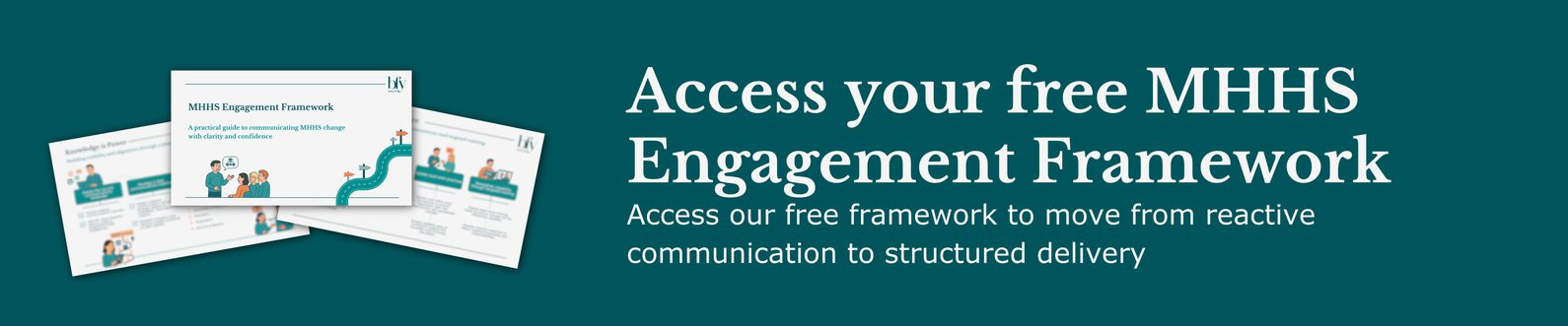
To help organisations move from reactive communication to structured delivery discipline, we've developed a practical MHHS engagement framework.
This downloadable guide translates live delivery experience into a clear, phased approach that leaders can apply immediately across their organisation. It provides a structured roadmap to embed engagement across the operating model, aligning communication, capability and ownership throughout the transition.
In practice, strategic engagement plans built on this approach have delivered external engagement levels more than three times the expected benchmark, demonstrating that structured, proactive engagement materially influences alignment, confidence and delivery outcomes.
Wherever you are on your MHHS journey, from early mobilisation through to migration, this framework provides a practical starting point for embedding engagement as a competitive advantage rather than a compliance activity.
For more information on how we can support your MHHS readiness, contact Jon Vincent.