


The October round has just closed. When renewals fall short, suppliers usually look to sales, while service is reviewed separately, if at all. Yet some losses recorded as price may have started with service issues months earlier, and renewals are increasingly decided before contracts end.
With April under way and 2027 plans being built on October's results, now is the time for sales and service to review October together. We look at when renewals are really decided, why service problems behind price losses go unseen, and six questions to act on before April.
Renewals are being decided earlier
Our analysis of market switching points to contract start dates spreading through the year. April and October are still the busiest months, but they carry less of the year's switching, and more business now moves in the months between them.
A switch only shows up when the new contract starts, so the decisions behind them were made weeks or months before. TPIs also tell us deals are locking in earlier. The window to protect a renewal now opens well before the contract ends, and there’s no point starting work on October renewals in August if the customer has already signed elsewhere.
Renewal is still a service problem
When something goes wrong on a business energy account, customers want someone who understands the problem, can make a decision and fixes it first time. Ofgem’s latest research into businesses’ experiences of the energy market1 shows how often that doesn’t happen. Businesses that had complained described being passed between teams, repeating their issue and chasing the supplier themselves. Of these, 76% planned to switch at the end of their contract, compared with 45% of all businesses.
The problems are rarely dramatic. They’re the everyday failures of customer success: slow or incomplete onboarding, missing or wrong bills, rates or terms that don’t match the contract, long call waits, responses taking 10 days, handoffs to offshore teams and emails that go unanswered.
In the mid-market, where most business comes through brokers, the impact goes beyond one account. As we set out in our July blog, brokers see patterns across their portfolios. A TPI that sees repeated problems with one customer starts to question how you’re treating the rest of its book, and that shapes where it places business next.
Every unresolved issue on a key account creates potential renewal risk, and if that customer leaves, sales has to win the value back elsewhere.
Why win/loss reporting misses it
Sales insight usually says price is still the biggest reason customers switch. When you talk directly to TPIs and customers, an underlying service issue is often a contributing factor. It rarely shows up in win/loss reporting, because price is the easier reason to give and to record.
Many customers never complain at all, and it’s starkest among smaller businesses. In Citizens Advice research published in September 20262, half of small businesses had a billing issue in the past year, yet many didn’t complain because of past bad experiences or a process that felt too complex. As our October article explored, more data doesn’t always mean better commercial insight.
Why the same problems come back
Most suppliers do fix service issues, one at a time. An account manager chases billing, someone in operations corrects a rate, a team leader approves a credit. The customer is sorted, but the cause remains, so the same problems come back elsewhere, or resurface when the customer reaches renewal.
Quick fixes also hide the scale of the problem. Each issue looks resolved, so nobody sees the pattern across a TPI’s portfolio until the renewal is lost.
The fix sits in the operating model, not the individual case. At one large B2B energy supplier, corporate customer service relied on manual workarounds, with most work tracked outside the system. We redesigned the operating model around building expertise and gave leaders a live view of performance and workload. Backlogs fell by ~80% and productivity rose by ~30%.
Six questions to ask about October now
Your October and April books won't look the same, but October can show where service may be affecting your renewals. Work through these six questions using your lost October renewals, then use the answers to decide what needs to change before April.
- Were renewals decided before you started working on them?
If so, map key accounts and TPI portfolios by when decisions are likely to be made, not when contracts end. - Were there service issues on those accounts in the six months before renewal, such as onboarding, billing, rates or response times?
If so, list the open issues on your April accounts now, starting with those worth most to you. - Did any of the losses you logged as price have a service problem first?
If so, count them before they shape your 2027 targets. - Did any TPI change how it placed business with you across its wider portfolio?
If so, talk to them about service on the rest of their book. - Were issues patched one at a time rather than fixed for good?
If so, give each recurring issue an owner, a lasting fix and a date before the renewal window opens. - Did those losses come from different segments or TPIs than your April book?
If so, apply October's lessons only where the mix matches.
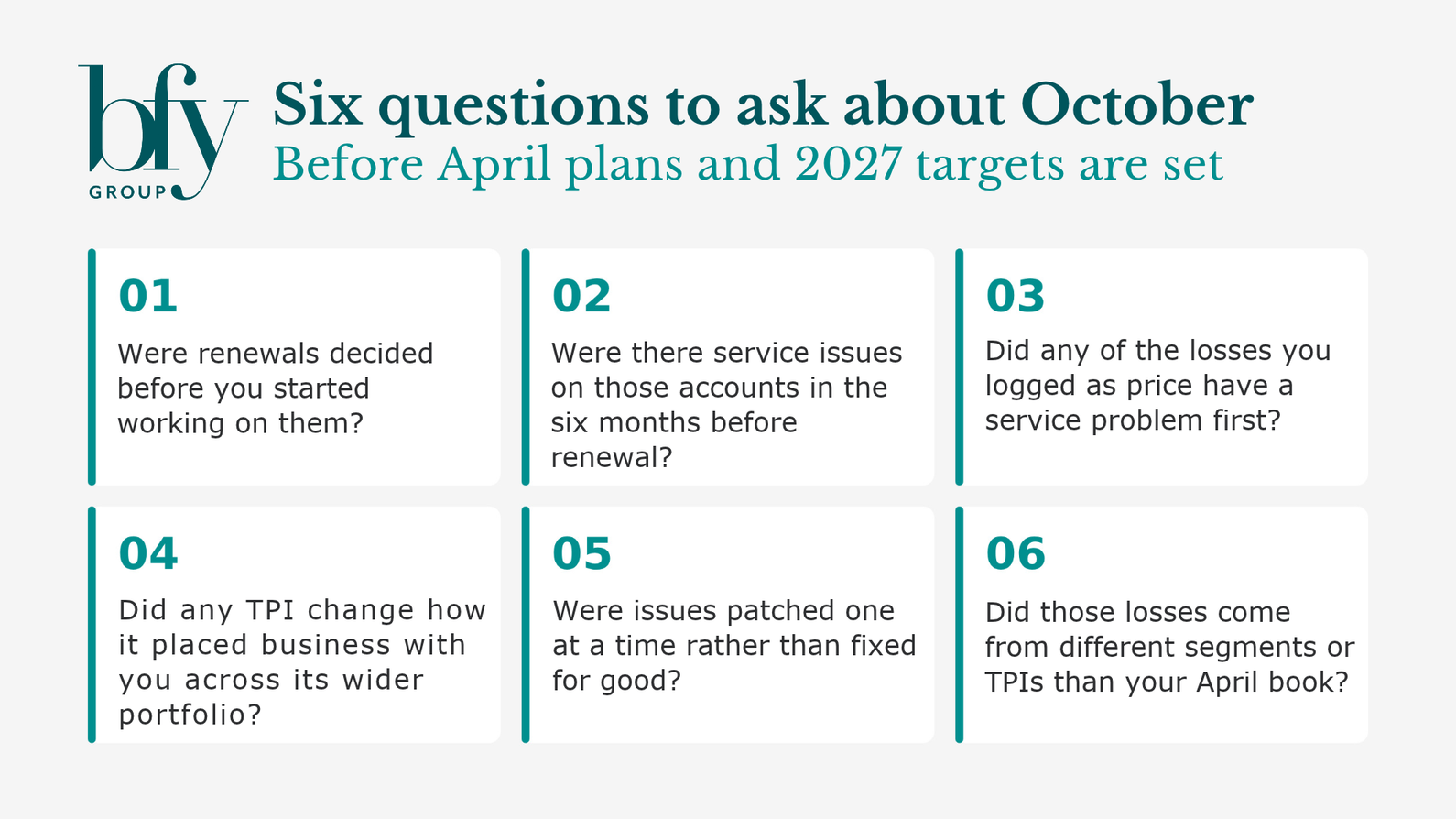
Each answer tells you something different about what happened in October and what to do before April. Taken together, they show whether losses recorded as price may also have involved service, timing or wider TPI relationships, and which of those lessons are relevant to your April book.
Build it into your 2027 plan
2027 plans are being finalised now, and many will draw on how October went. If October's losses are put down to price, 2027 targets will aim at the wrong problem: sharper pricing, when the real issue was the service customers had in the months before.
A better approach is to treat the health of each renewal as a service measure as well as a sales one. For every key account and TPI portfolio, that means tracking open service issues as renewal approaches; repeat contacts and time to resolve; billing accuracy and onboarding; and how many recurring problems have a lasting fix. Set alongside win rates and handling times, these measures show sales and service the same risks while there's still time to act, and give service teams a stake in renewal outcomes.
Talk to us
October’s lessons are only useful if they’re acted on before April. If you’d like help reviewing your October renewals, contact Matt Turner-Tait. We can look at your losses alongside their service history and your April pipeline and help turn what you find into your April plan and the right KPIs for 2027.